

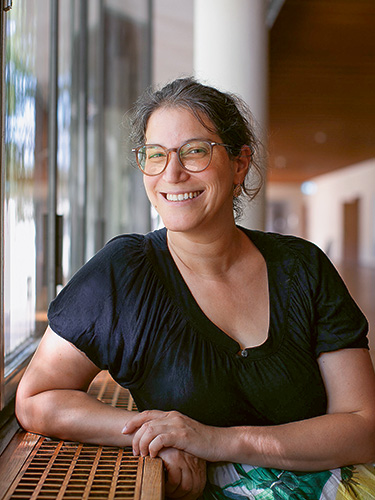
Susanna Zimmermann – Contemplator of complex forms.
Text: Angelika JacobsBecoming a mathematician wasn’t an obvious choice for Susanna Zimmermann. Today, she is a professor and one of the leading researchers in her field. She’s also learned to set boundaries along the way.
Key takeaways
- Susanna Zimmermann studies how complex geometric objects are related through algebraic transformations.
- As a professor at the University of Basel, she wants to help girls and young women overcome anxieties about mathematics.
- After experiencing burnout, she learned to protect her time and energy while continuing to earn international recognition for her research.
“It’s a bit like Stockholm syndrome,” Susanna Zimmermann replies, laughing, when asked why she’s so enthusiastic about her field of research. “If you spend enough time on something, you start to find it exciting.” There is, of course, more to her love of mathematics than that. This quickly becomes clear as she talks, combining reflections with her sharp sense of humor.
With a broad smile, she recounts in Swiss dialect her childhood in a mountain village in Glarus. “I liked math in school and was lucky that the people around me approved and encouraged my interest,” she remembers. Even so, studying math after her Matura wasn’t the obvious choice. In high school, she had decided not to focus on mathematics, which was dominated by the boys. “And they weren’t exactly very sociable.” She feared things might be the same at university.
After graduating high school, she spent a year working for a bank in Zurich to get to know the financial sector. But she wasn’t convinced. Meanwhile, she’d heard that Basel’s mathematics department had an informal feel to it. “I wanted to try studying math here, and I’ve never regretted it.”
From Basel to France and back
Today, aged 39, she works as a professor in the same department where she once studied. “It was a strange feeling, returning to Basel, but it’s also nice to experience the department from a different perspective.” Between her studies, her subsequent doctorate in Basel and taking up a professorship at her alma mater, she spent several years conducting research in France, including time in Toulouse and at the prestigious Mathematical Institute of Orsay at the Université Paris-Saclay.
She has made an international name for herself in her specialist field of birational geometry, receiving the Bronze Medal from France’s CNRS research center, an ERC Starting Grant and a Frontiers of Science Award. In summer 2026, she gave a lecture at the International Congress of Mathematicians, where the Fields Medal is also presented. An invitation to present at the congress is considered a particular international honor.
When donut and cup are related
Susanna Zimmermann hit upon her current research topic during her doctorate. “Birational geometry combines two areas of mathematics for which I had a soft spot even as a student.” On the one hand, you have algebra, in which variables and calculation rules are used to describe general connections. On the other, you have geometry, which focuses on shapes, sizes, distances and the spatial relationships between objects.
Zimmermann first uses modeling clay to explain the general concept: A donut and a cup with a handle can be morphed into each other without a hole appearing or disappearing. The two shapes look different but have a common structure. “My research is also about identifying when different-looking geometric objects are related on a deeper level,” she says.
Creative contemplation
The objects being studied are, however, complex mathematical spaces described using algebraic equations. They can be transformed into one another with the aid of specific calculation rules. Zimmermann explores such transformations and the structures they form together. “It’s a very creative process, contemplating mathematical problems and discussing them with others,” she says.
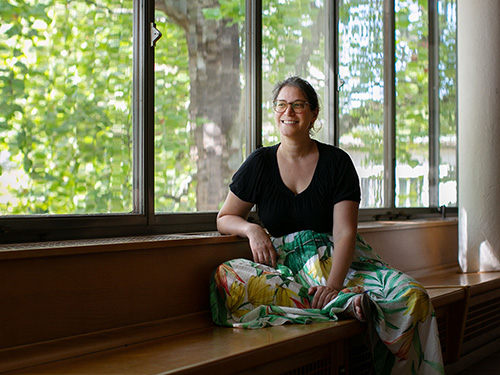
Her research may be difficult for laypeople to understand, but helping people overcome their anxieties around mathematics is extremely important to her. Her main aim is to attract girls and young women to the field. As a female professor, she is a visible role model. This includes balancing her work with her role as a single mother to a one-year-old son. She takes her child with her to conferences, along with a companion to help with his care. “I’m much more selective now than I used to be about the conferences I attend and the offers I accept.”
Personal transformation
Even before having a child, she had to learn to manage her time and energy. “To get research funding, you need scientific output. If you stick to normal working hours, you produce fewer results.” This lifestyle took its toll. After experiencing burnout in 2023, she had to undergo her own transformation, from a workaholic to someone with a healthier workload.
It was important for her to realize that being less present didn’t lose her any esteem. “The research community didn’t forget about me simply because I stopped attending every conference.” Despite setting conscious boundaries, she is respected both nationally and internationally for her contributions to research. In September, she won the 2026 Latsis Swiss Science Prize, one of the most important awards for early career researchers in Switzerland.
And she isn’t going to run out of fascinating questions any time soon: “While contemplating one problem, you constantly come across new, interesting aspects,” she says. Some have to be set aside until the time is right to return to them.
Susanna Zimmermann has been Professor of Birational Geometry at the Department of Mathematics and Computer Science at the University of Basel since February 2025. Her focus is on complex algebro-geometric transformations and how to understand their properties better. She lives in Basel with her one-year-old son.
More articles in this issue of UNI NOVA (November 2026).