

Crisis and disaster in antiquity.
Text: Christoph DieffenbacherAncient historians interpreted difficult times very differently than we do today. Classicist Gunther Martin believes their perspectives are especially worth revisiting in our own troubled times.
Key takeaways
- In ancient Greek, “krisis” meant a decision or turning point, rather than a prolonged period of turmoil.
- Ancient historians often interpreted wars and hardship as tests, consequences of past failings or transitions to a new order.
- The idea that crises interrupt an otherwise stable course of progress is just one way of understanding history.
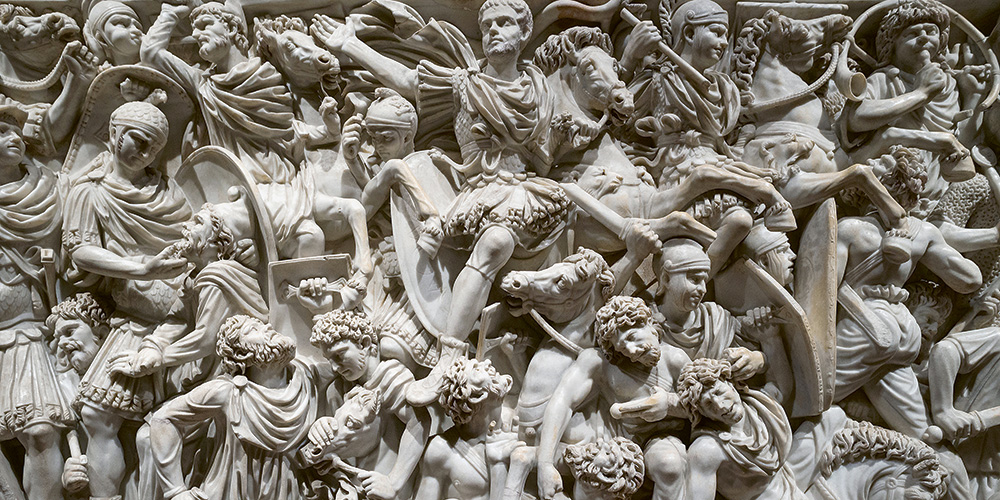
In the third century AD, ancient Rome found itself immersed in chaos — with rampant civil wars, famines and epidemics compounded by a widespread breakdown in trade networks and the economy. Armed Germanic tribes and Persian troops stalked the borders of the empire, and provinces such as Gaul and Syria broke away. Soldiers were proclaimed emperor only to be deposed again or even assassinated. Moreover, Christianity was increasingly calling into question the cults of the gods that ancient Romans had worshipped for centuries.
History books refer to these decades of poverty and decline in the Roman Empire as the “Imperial Crisis.” Yet this critical period did not affect the entire empire equally, and ancient societies were regularly affected by crises and conflicts — both before and after it: “Wars were an everyday occurrence,” says Gunther Martin, Interim Head of Greek Philology at the Department of Ancient Civilizations. Aggression and violence dominated people’s lived experiences, and gave later historians cause to explain and contextualize the past.
How the meaning of crisis has changed
The first thing the classicist noticed was that the modern term “crisis” had a very different meaning in antiquity. “In Ancient Greek, ‘krisis’ essentially meant a decision or a turning point” — for example, when a court was deliberating on a judgment or when it transpired whether a patient could expect to recover from their illness or not. In any case, the term did not refer to what we currently call a crisis.
By contrast, the word “crisis” is now applied to all manner of things, says Martin, citing a series of examples: “Banking, climate, COVID-19, Ukraine — it’s one crisis after another, and they’re all perceived as being somehow connected.” There is talk of permacrisis and multiple crises that then amplify one another. This can go on until — well, the crisis becomes personal.
The use of the word “crisis” to describe a moment of social upheaval is a relatively new development in the history of language. Indeed, this meaning did not become established until the 18th century. The Basel-based historian of art and culture Jacob Burckhardt (1818-1897) was one of the first to address the question of crises of the state, religion and culture, which he defined as “accelerated movements of the whole process of history.” Martin says that the word is understood in a similar, albeit not identical, way today: “We see stability as the normal state, and if someone disrupts the peace, we call it a crisis.”
How ancient historians interpreted war and hardship
Historians of antiquity took a very different view of periods of war and poverty and perceived the “dark sides of existence” differently than we do, he says. Painful eras could serve as an acid test for the population. These were sometimes the result of past failings or could be attributed to a specific cause — such as the downfall of a beleaguered emperor or an incompetent statesman.
In the fifth century BC, the Greek historian Thucydides took a more clear-headed view. He saw the Peloponnesian War between Athens and Sparta as part of an overarching order that was, in itself, stable. In the second century BC, the writer and politician Polybius set out, from a didactic perspective, that if the Greek world was collapsing, it was possible for a new culture to emerge in its place: namely, the Roman one. A century later, the historian Sallust described the political and moral decay of the Roman Republic in terms that were sometimes reminiscent of a disease.
Above all, it was the omnipresent crises seen in media reports today that inspired Martin to explore this term in greater depth. He was struck by the manifold ways in which ancient historians construed and interpreted wars and conflicts of the past. What’s more, he says: “Even if they were reporting terrible things, many historians wrote in a surprisingly matter-of-fact tone.”
Reforms and emergency measures
According to Martin, our belief in a kind of linear progress that is interrupted from time to time is fairly alien to the ancient world. A quick look at Greek and Roman historians may serve as a warning not to take our own perspective for granted. Indeed, ours is just one of several possible perspectives — namely, the predominant narrative or the current master narrative, as modern historians call it. Ultimately, although the state continually sought to respond to the Imperial Crisis of the late Roman period by introducing reforms and emergency measures, these steps could only delay the eventual fall of Rome for so long.
More articles in this issue of UNI NOVA (November 2026).