

The man who gets Basel crowds cheering.
Interview: Evelyn WeissheimWhen it comes to organizing large-scale events, Beat Läuchli knows his stuff. In Basel, he has organized events such as the Eurovision Song Contest and the European Artistic Gymnastics Championships. Today, he is Chief Operations Officer at FC Basel. He explains what drives him and how his time at the University of Basel shaped him.
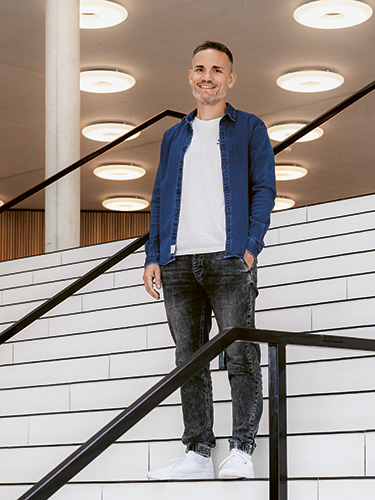
Beat Läuchli, movement features in every aspect of your life. Is that a coincidence?
Sport is my passion. I simply don’t enjoy doing the same thing for long stretches of time; I’m more interested in new things. That’s also what makes event management so exciting: You’re given a framework, you develop a concept for an event, and finally you get to see the results of your work. It’s phenomenal. And then you’re given a new framework. Going through the same processes for 40 years wouldn’t work for me.
What motivates you to devote so much energy to your work?
I want to experience the emotions that these events create. There’s nothing more amazing than seeing people buzzing with joy as they leave the stadium after a great soccer match or concert, for example.
Do you sometimes worry that you won’t be able to elicit those emotions?
No. You have to accept that your influence only extends so far. I’m not responsible for what happens on the soccer pitch or on the stage. My job is to create the best possible setting and to put clear processes in place to ensure safety. I don’t feel responsible for the audience’s emotions. But I’m grateful that I’m allowed to witness them. Planning my own birthday is more stressful (laughs).
The Basel Carnival or Fasnacht — in which you are also involved — is on the UNESCO Cultural Heritage of Humanity list. Eurovision is a global event, and FC Basel is one of Switzerland’s leading soccer clubs. What is it that attracts you to such big events?
Big involves a certain degree of complexity: Different issues, several stakeholders but also a political and social element. There are various perspectives to consider, and sometimes you have to change your own mindset, too. At FC Basel, for example, there’s match day; but there’s also the day-to-day running of the business and the strategic work, such as continuing to maintain and develop the stadium. This mix is exactly what I like about my current role.
Which project made you feel as though you’d created something lasting?
The Eurovision Song Contest was something unique for Basel; an event of that magnitude will be remembered for a long time. The most exciting thing was helping to shape how the event was received by the people of Basel. We had to listen to everyone and show sympathy for those who weren’t happy about a huge, multiday festival taking place on their doorstep. But in the end, it was well received and everyone celebrated together. That was the best thing. We had a great team, but we were also really lucky with the things we couldn’t fully control: The weather was wonderful, and while security issues are, unfortunately, always a possibility, we were spared any major incidents.
Planning and oversight are essential to your work. But carnivals, sporting events and concerts thrive on emotions, too. How do you balance that?
My job definitely makes me emotional; I get annoyed or excited. These emotions feed into our process development from the very start. But what’s even more important is that I’m aware of and address my colleagues’ emotions. After all, making an event happen is very stressful and triggers emotions that are also key to our success. So planning isn’t totally devoid of emotion.
What role has the University of Basel played in the path your life has taken?
I decided to study sport purely because of my passion for the subject. We always used to joke: “What are we actually going to do when we graduate? Start all over again!” Then I studied business, which felt more anonymous. That suited me. I began working while still at university, and it was less obvious if I missed a lecture. The university enabled me to take my next steps, but I was the one who then decided where those steps took me.
Is there a project you’d still like to make happen?
Actually, there’s one with a connection to the university: I’d like to bring the World University Games — kind of like the Summer Olympics for students — to the region, together with the universities of Freiburg im Breisgau and Strassburg. I don’t have capacity for the project at the moment, but maybe one day. I’ll let you know when the time comes!
Staying connected.
If, like Beat Läuchli and Salome Thommen, you’d like to stay in touch with the University of Basel and with other alumni, then AlumniBasel is the place for you. As a member, you’ll remain part of the network and enjoy access to events and information exchange while also supporting our alumni work. For more information, visit www.alumnibasel.ch.
More articles in this issue of UNI NOVA (November 2026).