Landscape is formed in the mind and through dialog
How do we perceive our surroundings, and what criteria do we use to evaluate them? The philosopher Antonietta Di Giulio is researching this topic. In this interview, she explains how different concepts of landscape can lead to conflicts and how policymakers can answer them.
16 September 2026 | Noëmi Kern
Dr. Di Giulio, beautiful landscapes sometimes influence our choice of holiday destination or weekend plans. What do we actually mean when we talk about landscape?
When we talk about landscape, we’re usually only thinking about the nature we can see. But built-up areas are also landscapes. This is often forgotten. And landscape isn’t simply there; it’s created and shaped by humans. A landscape includes visible, physical elements such as mountains, roads and houses, but also invisible aspects such as memories, emotions, historical events and the possibilities that we associate with a particular place. That is, we shape and create landscape not only physically and materially, but also through thinking and speaking. What matters is how we perceive the various elements. This shapes our understanding of a landscape. Is, for example, a road part of it or is it a disturbance?
What makes a space a landscape?
This has a great deal to do with societal perceptions, which can also change. As researchers, we refer to these notions of landscape as landscape narratives. These have three dimensions: What belongs to a landscape? What benefits does it provide? And what story does it tell? Narratives turn a “space” into a “place”. Societal developments also shape narratives. Alongside societal narratives, there are also individual narratives, and these influence one other.
What do you mean by individual narratives?
We all develop our own notions about what belongs to a landscape, what story it tells and what functions it should perform.
Our own background, everyday life, job and personal experiences all play an important role in this. Accordingly, it can be perceived as a loss of history or identity when, for example, certain buildings disappear or a particular tree is cut down. Landscape is always emotionally charged.
In the debate over whether and where solar panels and wind turbines should be installed in order to advance the energy transition, objectives such as landscape protection, environmental protection and nature conservation are pitted against one another. Not everyone understands these terms in the same way...
Exactly. When it comes to renewable energy, differing notions often clash. Those for whom landscape is untouched nature will find wind turbines or solar panels disruptive. Those for whom, on the other hand, landscape is a space designed and used by humans see them as an expression of innovation and progress. The energy transition does therefore also impact concepts about what a landscape should look like and what it is expected to provide. Solar panels and wind turbines are now part of the landscape in many places, and people are getting used to them – which may lead to a shift in landscape narratives.
Which landscape narratives are currently particularly influential in Switzerland?
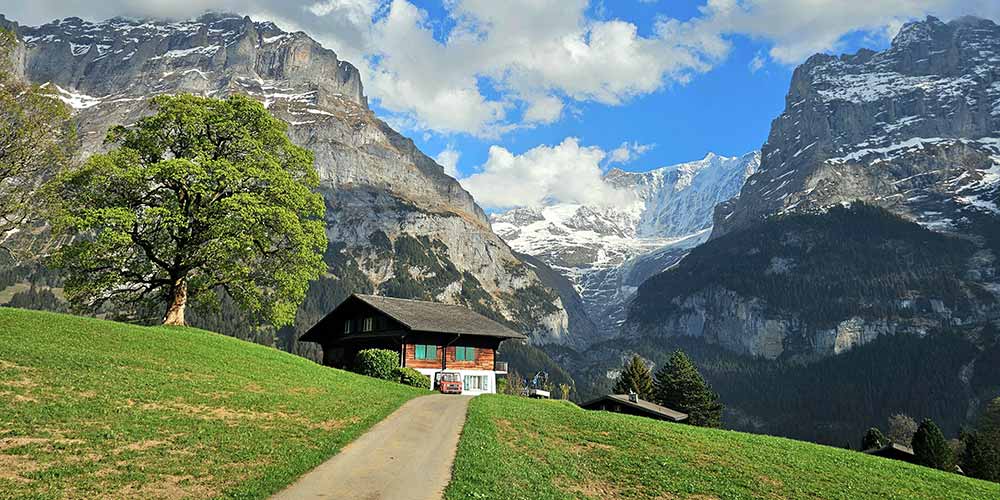
Two narratives are particularly powerful because they are also linked to the national identity and are therefore particularly widespread. The first is the notion of the untamed alpine landscape, which is said to define Switzerland’s character. The second is the idea that the Swiss landscape is fundamentally rural and must be protected from urbanization. These images are very much part of the societal fabric and are repeatedly reproduced in advertising and in representations of the nation. While images of mountains, cows or rural idylls are often used to indicate “Swissness”, urban or industrial spaces are less visible. This also raises the question of who actually recognizes themselves in these widespread images and narratives, and who and what are excluded.
What do you mean by that?
Let me give you an example: if we understand landscape as untouched nature, we exclude a large part of what makes up our daily lives. In Switzerland, most people live in small cities or in the catchment area of larger cities, commonly referred to as metropolitan areas.
While there are many narratives about mountain landscapes, we rarely talk about these built-up landscapes, or they are simply portrayed as a threat to nature. There is also very little academic research on urban and peri-urban landscapes and the narratives referring to them. I find this extremely regrettable. It’s important to include these areas.
Do landscape narratives differ across different population groups or regions?
Yes, very significantly indeed. What is particularly interesting is the difference between people who live in a particular landscape and those who view it from the outside. For instance, people from cities often have different narratives about alpine regions than those who reside and have to make a living there. These different perspectives and needs produce different answers to questions about wolves, nature conservation or tourism, and lead to debates that result in political negotiation processes or even conflicts.
How should policymakers respond to these different needs?
Competition between narratives is the norm, as the different narratives are sometimes difficult to reconcile with one another. It’s not about who’s right; landscape narratives are differing perceptions of the same reality. This must be recognized.
Policymakers need to mediate between the different needs and perceptions, while at the same time reflecting on and disclosing which narratives they are promoting in landscape design. Of course, it is not only narratives that play a role here, but also practical issues and other topics such as housing, infrastructure and the environment.
What advice would you give to policymakers on dealing with landscape narratives?
Policymakers should be aware that every decision reinforces certain narratives and weakens others. In my view, it is therefore important to include as many perspectives as possible and to deliberately weigh up the impact decisions have on different population groups and their sense of identity. It’s not about pleasing everyone, but about treating this diversity with respect.
About the research project
The study by Antonietta Di Giulio and Rico Defila (also from the University of Basel) was produced as part of the “Landscape quality in light of societal narratives” project, which was funded by the Federal Office for the Environment (FOEN). It presents the objectives, methodological approach and results of the project, which was based on the assumption that landscape quality is not an “objective measure” but rather the result of societal negotiation processes. The project compiled societal landscape narratives that are likely to be relevant in Switzerland. The findings led to recommendations on how landscape policy and development can engage with social landscape narratives. They are aimed at government bodies and other societal actors who develop and/or implement landscape-related concepts, scenarios, strategies and measures.
Original publication
Di Giulio, Antonietta; Defila, Rico
Landschaftsqualität im Licht gesellschaftlicher Narrative
Universität Basel (2025), doi: 10.5451/unibas-uv265334