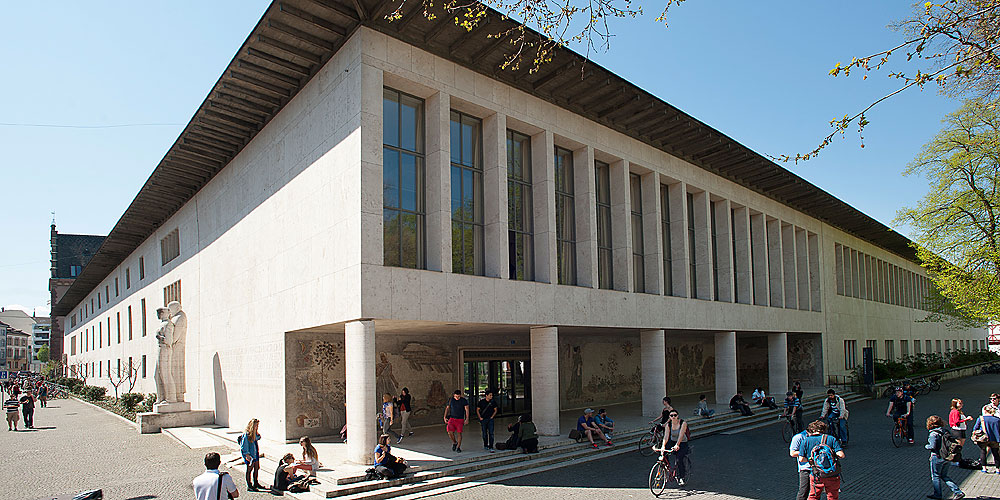
In Focus: Sindi-Leigh McBride speculates on work, climate change and narratives
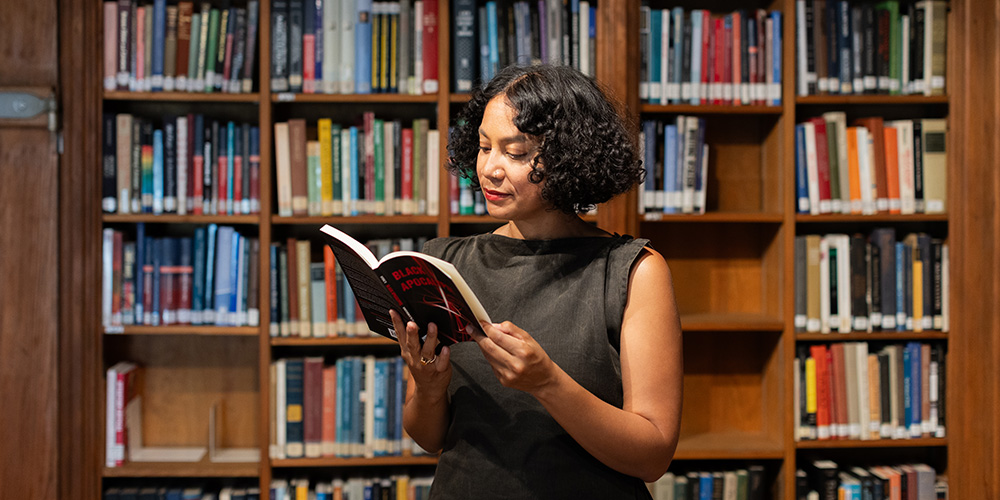
Sindi-Leigh McBride investigates the work of making a living, making a life, and where the two intersect in changing climates, looking to novels and films for visions of the future in a world undergoing profound change.
11 August 2026 | Tobias von Rohr
In the dappled quad of the English department, Sindi-Leigh McBride greets numerous colleagues passing through, which is impressive considering that she is a new staff member. Before joining the department as a postdoctoral researcher associated with the “Anglo Genres for Atlantic Futures” project led by Professor Philipp Schweighauser, McBride held a Presidential Postdoctoral Fellowship at Princeton University.
In her research, she explores work and the global climate crisis in speculative fiction. “The intersection of climate change and precarization of work is understudied, especially in the cultural domain, including literary criticism,” McBride explains. “But analyzing works from different geographic and cultural environments can illuminate historical structures of exploitation and provide important insights into the future of work.”
New approaches to climate knowledge
This approach of exploring the social and cultural meanings of climate change is simultaneously fresh and familiar terrain for McBride. For one, her doctoral research explored the politics and poetics of climate change in South Africa and Nigeria, investigating contemporary art and literature as sources of climate knowledge. Despite being new to the English department, she is not new to the University of Basel, having completed her PhD at the Centre for African Studies in 2024, funded by a Swiss Government Excellence Scholarship.
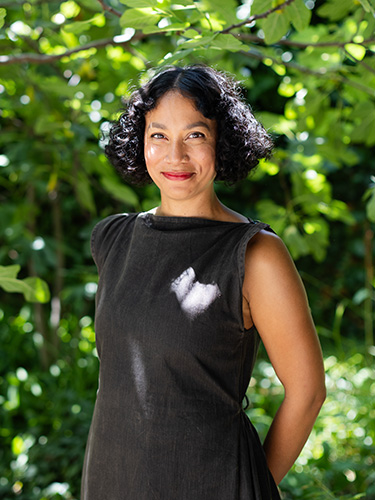
She also has experience researching climate change and youth livelihoods at the Human Sciences Research Council, the largest research institute dedicated to the social sciences in South Africa, her home country. “I’m interested in how the way we work changes in changing weather conditions. And sometimes it is cultural workers who provide the most revealing insights into these changes,” she says. She cites the example of acclaimed Swiss filmmaker Jacqueline Zünd, whose new documentary Heat (2026) explores the impact of rising heat on human relations, including work. Earlier this year, McBride organized a screening of Zünd’s debut feature film Don’t Let The Sun (2025), which deals with similar themes through fiction. The public event at Stadtkino Basel included a lively discussion with the director.
Speculating on the role of culture in uncertain futures
In her work, McBride draws from labor ethnographies and political economy studies, pairing these with literary criticism and environmental history. This interdisciplinary approach reflects her academic journey: “I started studying law in my hometown, Johannesburg, but this soon developed into a deep interest in knowledge about geopolitics.” McBride holds MA degrees in International Relations and Political Communication from the University of the Witwatersrand and the University of Cape Town. Before coming to Switzerland in 2019 to begin her doctoral program, the now 38-year-old worked in different research capacities including for an NGO and for the South African government.
Her interests really come alive when she talks about art and literature. “Independence leader Amilcar Cabral, one of the most intellectually formidable figures in history, said that culture is simultaneously the fruit of a people's history and a determinant of history. So contemporary culture – not just novels and films, though that’s what I work on – is a critical site for thinking seriously about labor and livelihoods as environments are transformed by climate change.” McBride explains that sometimes fiction can help us to understand which professions are most at risk of disappearing, or which new forms of work are emerging. Or as Arundhati Roy, a writer who has greatly influenced McBride, puts it: "fiction is the truest thing".
Building bridges between academia and the public
In addition to her research and teaching, Sindi-Leigh McBride juggles many different roles: she is the mother of a young child, writes creatively, and enjoys running marathons. Striking a healthy balance between university work, cultural work, and family work is important to her, even though she admits with a smile: “To be honest, I have to squeeze in work whenever I can. You know what they say to new mothers, write when the baby writes.”
It is important to the researcher that the pursuit of knowledge does not end at the university gates. She regularly takes part in public-facing activities, such as designing and facilitating a free public reading group at the Kunstmuseum Basel. She is committed to bringing together different people – including, but not only, academics and artists – and believes that “universities can be spaces to support knowledge exchange between people from all walks of life, irrespective of their background or training.”
Given that the importance of the issues she is exploring – labor, climate change and narratives – are likely to increase in both relevance and urgency, her call to bring together the arts and sciences to learn from the stories we tell is critical.
In Focus: the University of Basel summer series
The In Focus series showcases young researchers who play an important role in advancing the university’s international reputation. Over the course of several weeks, we will profile academics from various fields – a small representative sample of the more than 3,000 doctoral students and postdoctoral researchers at the University of Basel.