Evacuated and sealed: How the University Library protected its treasures from the war
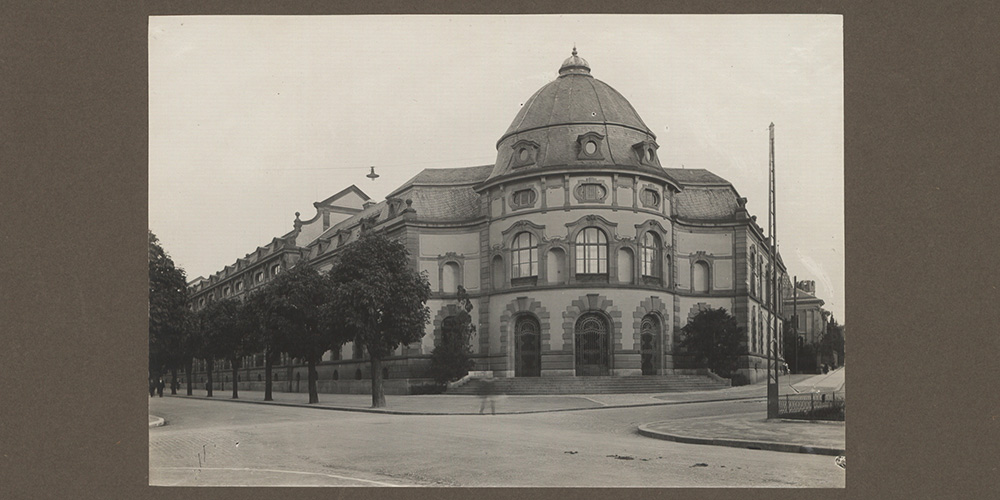
As World War II drew closer, the University Library Basel (UB) moved valuable holdings to safety and took precautions against bombing and espionage. Noah Regenass, Head of Historical Collections, examined the relevant archival sources and also uncovered contradictions in the library’s operations at the time.
20 August 2026 | Noëmi Kern
Dr. Regenass, the University Library is celebrating its 555th anniversary. Why did that lead you to focus specifically on the UB during World War II?
It’s a fascinating chapter in the library’s history that has received little attention so far—not only in Basel, but at other Swiss university libraries as well. But as provenance research becomes increasingly important in libraries, the subject is receiving more and more attention.
Switzerland was largely spared the war. Why did it still have consequences for the University Library?
As a border city, Basel was close to the front between Germany and France. Bombs fell on the city twice, in 1940 and 1945, so the threat was real. Karl Schwarber, director of the University Library at the time, recognized this.
Libraries hold important cultural assets and are therefore often targeted in wartime. Schwarber took precautions early on to protect the UB’s collections.
What exactly did Karl Schwarber do?
As early as 1938, after Nazi Germany annexed the Sudetenland, he drew up a contingency plan with Fritz Hauser, a member of Basel’s Executive Council, and arranged storage locations for valuable manuscripts. Valuable printed works were to be placed in the vault of Basler Kantonalbank, which was then located next to the Hotel Dreikönig. The manuscripts were to be stored at Engelberg Abbey. When war broke out in 1939, everything was ready, and Schwarber could put his contingency plan into effect. These measures had also been approved by the Basel Executive Council. Agreements with Basler Kantonalbank and Engelberg Abbey set out the storage arrangements, and the inventory was checked once a year. Some printed works and manuscripts were also temporarily brought back to the UB for research.
Which works were moved?
The inventory lists tell us. Among the manuscripts were primarily Basilensia—that is, works and documents with a particular connection to Basel—including writings by Thomas Platter, collections of letters by humanists, and, of course, manuscripts by Erasmus of Rotterdam. Printed works and manuscripts in Hebrew, known as Hebraica, were also evacuated, as was the Koran printed in Basel in 1542. Schwarber knew that the Hebraica in particular would have been destroyed or confiscated if they had fallen into Nazi hands. The collections would also have been at risk if the UB had been hit by bombs. After the war, they were returned to Basel in 1946.
What other precautions were taken?
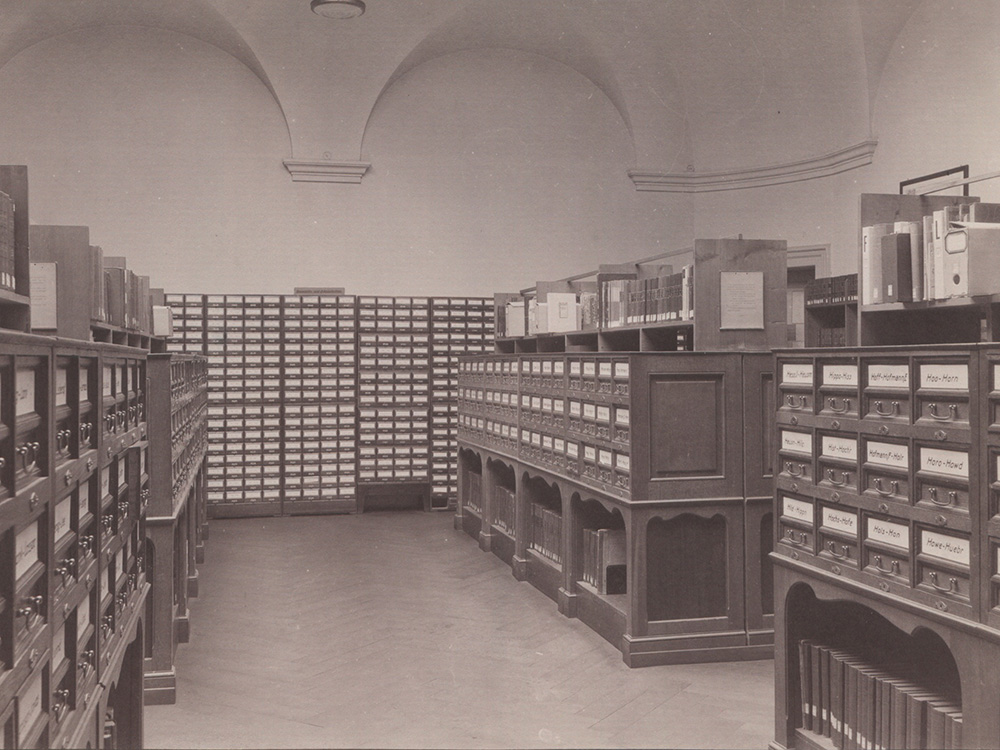
The card catalog—then the catalog of the UB’s holdings—was moved to the library basement after the outbreak of war to protect it from possible bomb damage. The map archive was also sealed so that spies could not use it to obtain information about Swiss topography.
The UB’s director seems to have had a good sense of what was happening.
That’s right. Overall, he responded very calmly, systematically, and with foresight. That applied not only to protecting the collections but also to his staff. During the war, the UB operated with only a skeleton staff. Many employees were called up for active military service. Karl Schwarber tried to keep as many as possible at the library in Basel, arguing that the University Library had to remain open for teaching and research.To make that possible, he also recruited new staff. Even in this situation, however, he did not want to hire women as academic librarians. He apparently did not believe they had the necessary qualifications. This is clear from his response to a female applicant: “Further developments will show whether we also need to bring in female temporary staff. For the time being, I see no need to do so.” He wrote this even though the UB was facing a ten-day closure because of staff shortages.
In the art world, looted property surfaces time and again. Did the University Library Basel also take advantage of people in desperate circumstances to acquire special collections?
Provenance research is much more difficult for books than for works of art because there can be many copies of the same edition. In the archives, however, I found a receipt for books the UB bought from a Jewish man from Frankfurt.
The exact circumstances of the transaction are not documented. There were also plans to buy the holdings of an antiquarian bookseller that had been put up for sale because of the pogroms. So people were aware of what was happening in Germany and that books were being destroyed. In short, given the current state of research, the circumstances surrounding many acquisitions are still not entirely clear. I don’t think we should be too quick, from today’s perspective, to judge decisions made at the time.
What ideological position did the University Library take?
At the time, the University of Basel leaned to the left, in line with the government, and the UB was able to follow suit. Karl Schwarber showed no reluctance to engage with Jewish people. In correspondence with libraries in the German Reich, the salutations “Heil Hitler!” and “Deutscher Gruss” (“German Greeting”) do not appear; the usual sign-off is “Mit kollegialem Gruss” (“With collegial regards”).
The UB also purchased communist literature because research should function independently of ideology. I find it remarkable that they tried to maintain an academic environment that was as neutral as possible.
What surprised you most about your research?
The picture is still far from complete, and I have many unanswered questions. That is also because many Swiss university libraries have not yet examined this chapter of their history. Hopefully, they will do so in the coming years.
Public Evening Event with Noah Regenass
World War II posed major challenges for the University Library Basel. Using previously unpublished archival sources, the event shows how the UB responded to the dangers of the war.
Wednesday, August 26, 6:00–7:15 p.m., lecture hall on the 1st floor of the University Library Basel, Schönbeinstrasse 18–20, Basel
Admission is free; no registration is required.