Odysseus in southern Italy
As Greece expanded, Homer’s epic also spread to the western Mediterranean. A search for clues in Calabria, where the builder of the Trojan Horse is said to have been buried and where archaeologists from Basel have been conducting excavations for many years.
29 September 2026 | Béatrice Koch
At the end of Christopher Nolan’s film The Odyssey, Odysseus leaves his home of Ithaca and sails west with his wife Penelope. It’s a scene that doesn’t appear in Homer’s original work. Yet for Martin A. Guggisberg, professor of classical archeology at the University of Basel, it still makes sense.
Although the Trojan War and Odysseus’s travels date back to the 13th or 12th century BCE, Homer tells the story from his own time around 700 BCE, when thousands of Greeks left their hometowns to establish new settlements in Sicily and southern Italy.
“This expansion is reflected in The Odyssey,” explains Guggisberg. “It is believed, for example, that the sea monsters Scylla and Charybdis symbolize the danger of shipwrecks in the Strait of Messina, and that Homer placed the gateway to Hades in the Phlegraean Fields near Naples.” For Homer and the Greek settlers, Odysseus embodied the archetype of the cunning sailor who knew how to assert himself in a foreign world full of dangers.
However, the heroes of the Trojan War were regarded not only by the Greek settlers but increasingly also by the local population as cultural role models who people looked to for inspiration. One example of this is Epeius, who is associated with the settlement of Francavilla Marittima on the Gulf of Taranto.
-
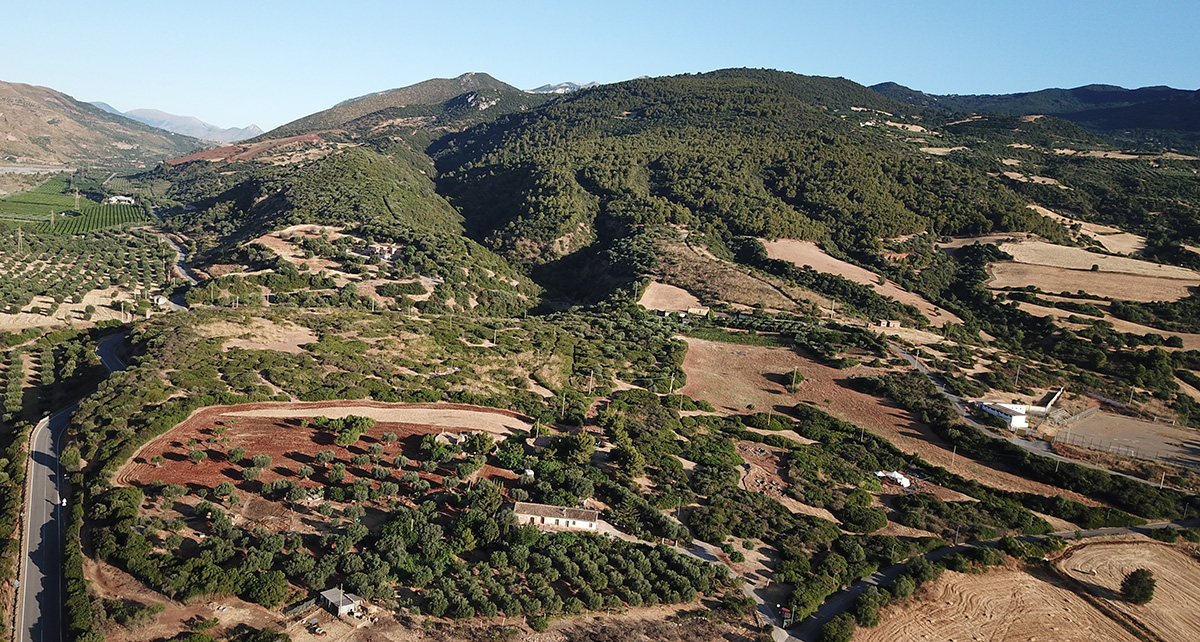 The drone photo shows the burial ground as well as the settlement and sacred hill near Francavilla Marittima in Calabria (Italy). The white tents mark the “Est” excavation site. (Photo: Francavilla Marittima Project)link.zoom
 -
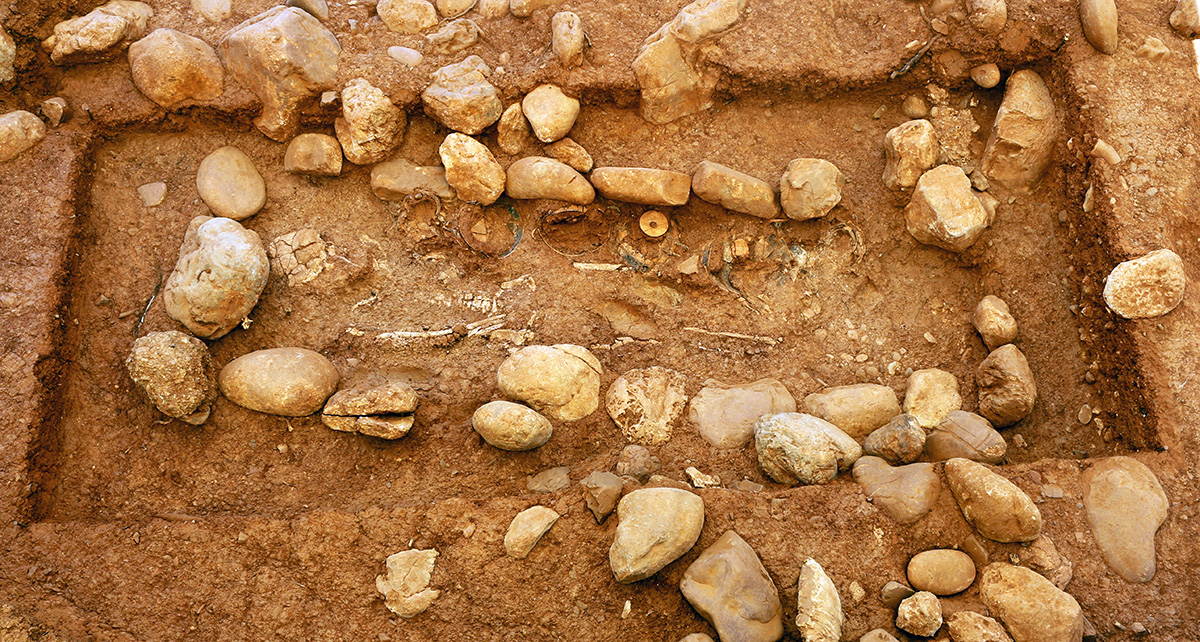 The “Rialzo 8” tomb dates from the 6th century B.C. The grave goods placed along the left side of the deceased’s body consist of nine ceramic vessels, including drinking bowls imported from Athens. (Photo: Francavilla Marittima Project)link.zoom
 -
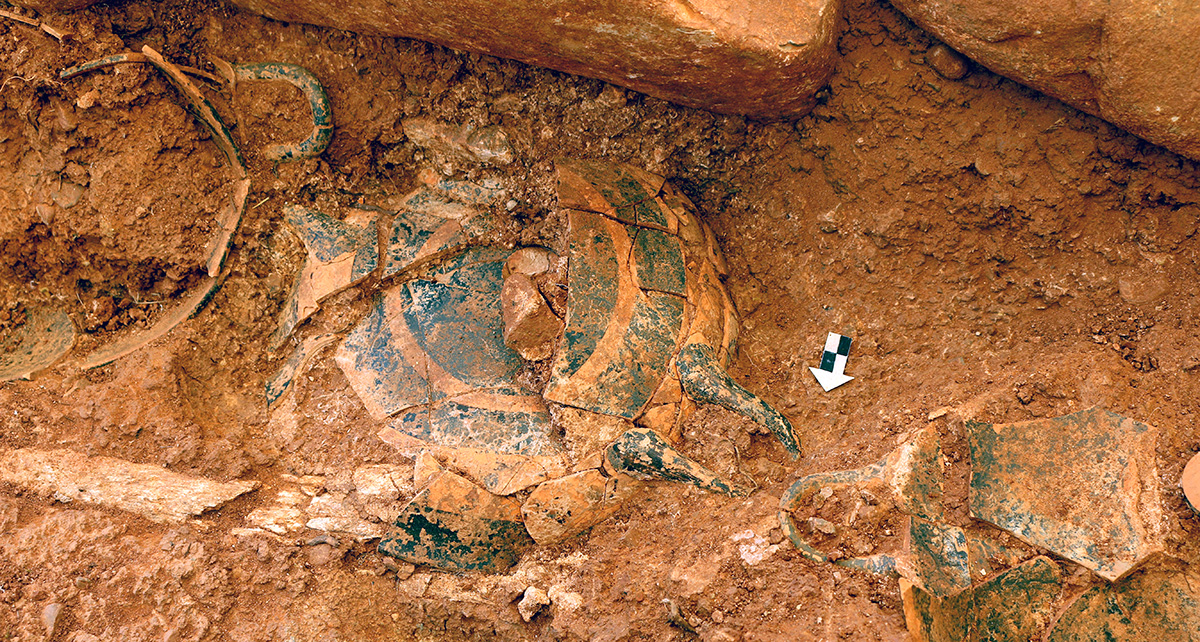 Close-up of an Attic drinking bowl that was placed upside down in the grave. (Photo: Francavilla Marittima Project)link.zoom
A hero to the Greeks and locals
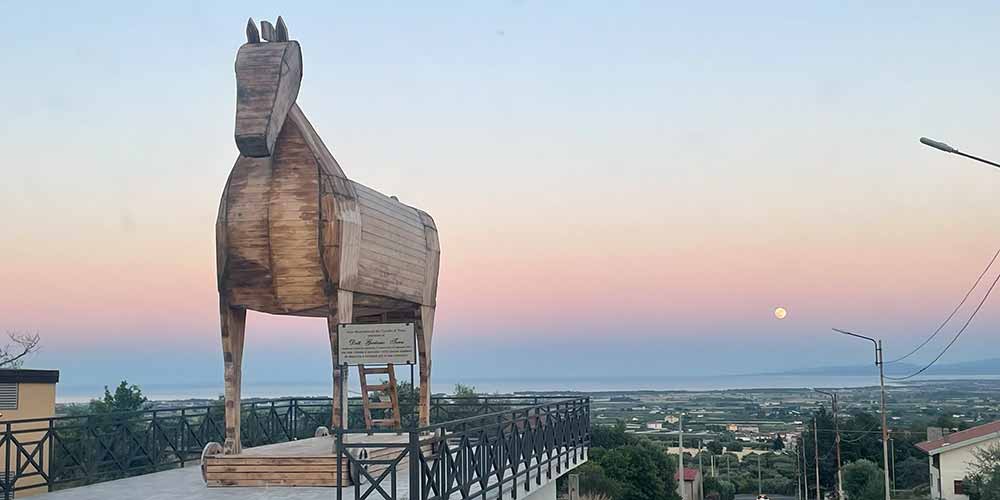
Epeius is a little-known hero, but he is still remembered for an extraordinary feat: according to Homer, he was the carpenter who built the Trojan Horse. In Virgil’s account, he is one of the men who climbed inside the horse. Upon his return, he founded a city near Francavilla Marittima and consecrated his tools to Athena at the local sanctuary.
“The myth is still very much alive among the local population to this day,” says Guggisberg. Since 2009 he has been in charge of the excavations of a burial ground near Francavilla Marittima, which is characterized by rich graves dating from the time of these early contacts. Finds of burins and chisels show that woodworking was of particular importance in southern Italy. This might explain why Epeius is venerated at this site.
“Men were buried with their weapons or their tools. This shows us that not only a man with military skills but also a good craftsman could be a leader.” Odysseus was known to be both: a cunning warrior as well as a skilled carpenter who built his own raft and marriage bed.
Traces of cultural interaction
“When it comes to the graves of the local population, we are interested in the question of cultural interaction: how did the people who were already living there react to the arrival of the Greek settlers? What did they adopt from them, and what did they not?”
One example of this is an ornate longsword that archaeologists from Basel discovered in Francavilla. This type of weapon originated in Greece and was adopted by local leaders towards the end of the 8th century BCE, just as it was disappearing from Greece.
-
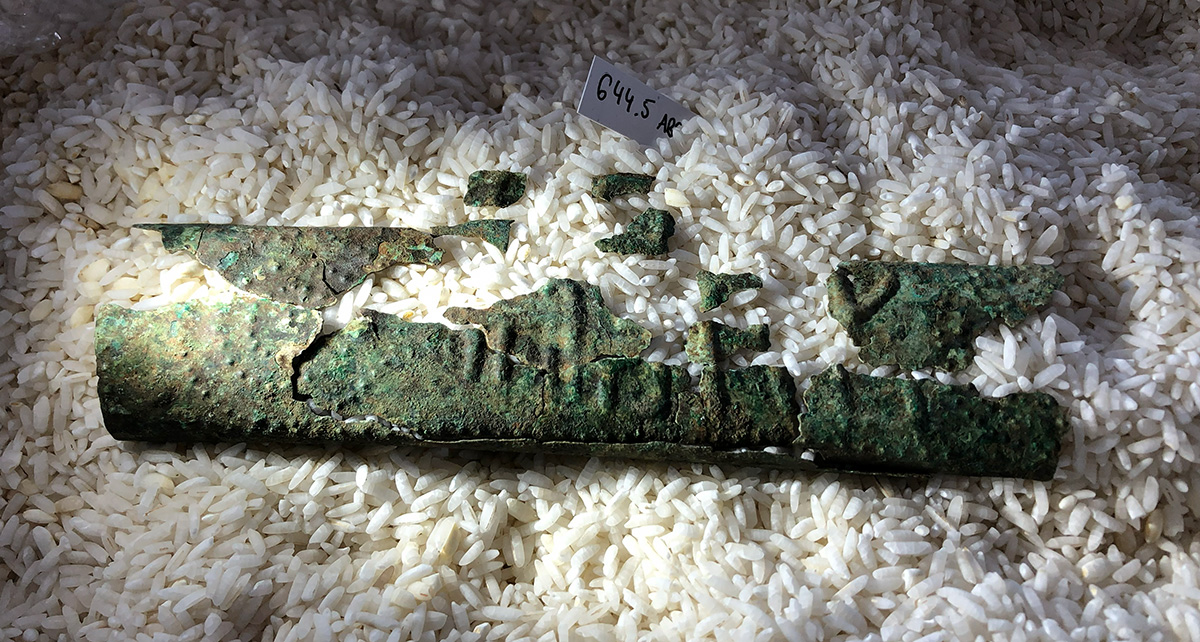 Fragmented sword scabbard from Grave “Est 11” with stamped decoration. (Photo: Francavilla Marittima Project)link.zoom
 -
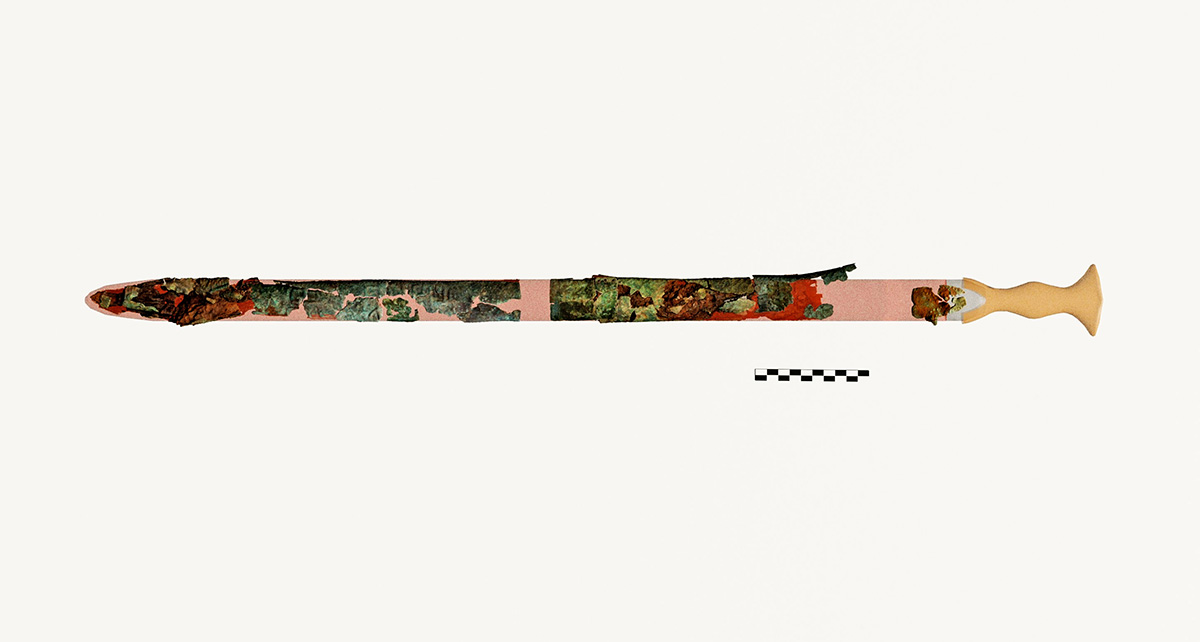 Photographic reconstruction of the iron sword with a bronze scabbard from the “Est 11” grave: Using CT data and numerous photos, the researchers created a 3D model that serves as the basis for this depiction of the heavily fragmented sword. (Image: Francavilla Marittima Project, 3D reconstruction: M. Ernste/N. Spichtig)link.zoom
 -
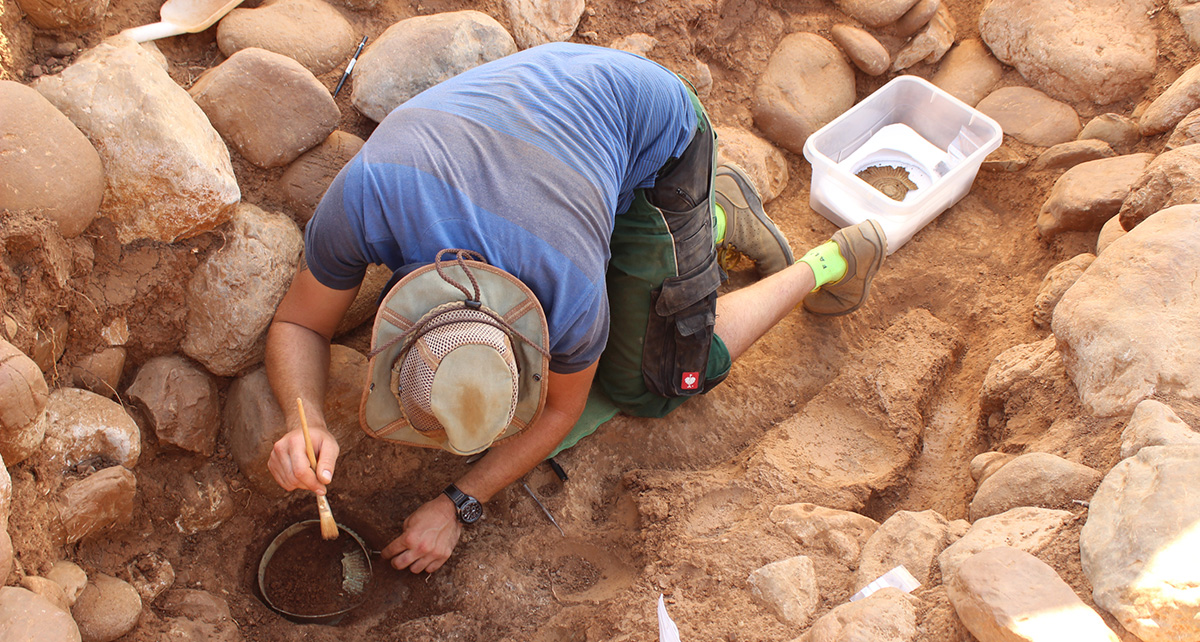 A student from the University of Basel unearthing a bronze ribbed bowl from the male grave “Est 11.” Next to his legs, The sword is still buried underground. (Photo: Francavilla Marittima Project)link.zoom
 -
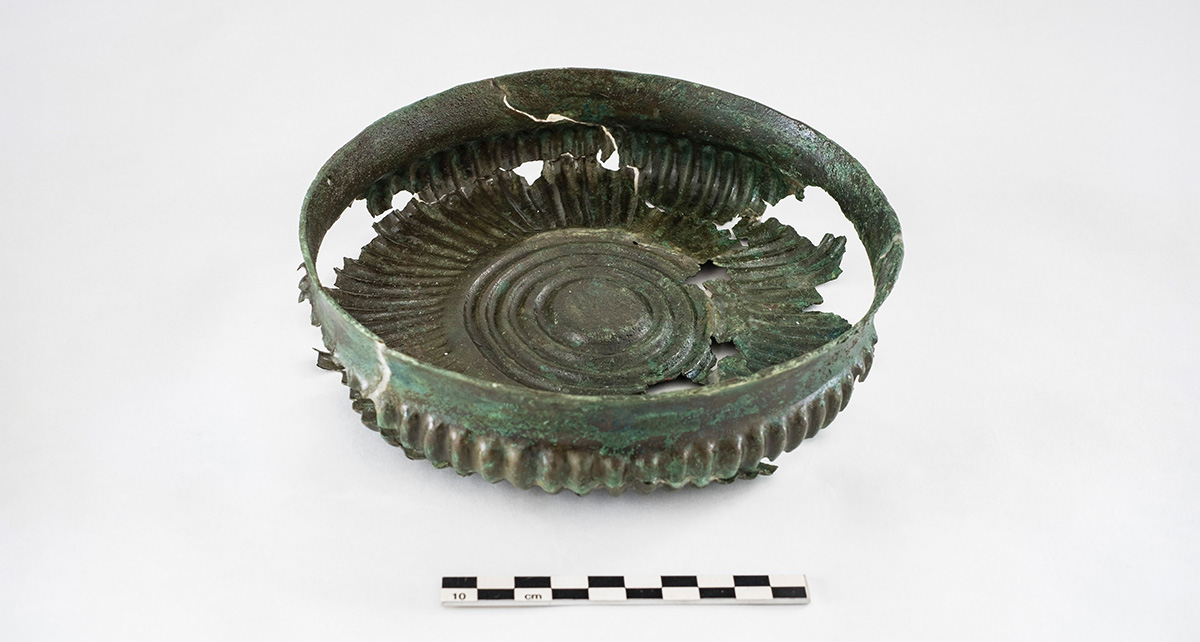 Bronze ribbed bowl from the male grave “Est 11.” (Photo: Francavilla Marittima Project, Victor S. Brigola)link.zoom
“The longsword was a weapon for heroic duels, as described by Homer. In southern Italy, they continued to be important. In Greece, on the other hand, tightly organized formation armies emerged during this period, for which the longsword was too unwieldy.”
Trade as far as Athens
This exchange continued in the period that followed. For a long time, the prevailing view was that the indigenous population was oppressed and exploited by the Greek settlers. This theory has been revised, not least due to recent excavations. This summer, for example, a 6th century BCE tomb was uncovered containing a rich collection of Attic black-figure pottery, particularly drinking bowls. “This shows that there was a local elite that traded with Athens and could afford to place these Greek vessels in a tomb.”
One of the bowls shows a fight between two men, each with a woman standing behind him. “The depiction likely also refers to Homer, where heroes such as Achilles and Hector are often accompanied by goddesses. The find reveals that the Trojan past was still significant here in the 6th century.”
Excavations in Francavilla Marittima
Since 2009, the Division of Classical Archaeology in the Department of Ancient Civilizations at the University of Basel, under the direction of Professor Martin A. Guggisberg, has been conducting excavations at the “Macchiabate” necropolis near Francavilla Marittima (province of Cosenza) in Calabria. Further information on the excavation campaigns and research findings can be found on the project website (in German/Italian).