Light engines in the quantum world
What is heat, and what is useful work if a machine consists only of an atom and light particles? In modern quantum technologies, this kind of question connects thermodynamics with quantum physics. Researchers at the University of Basel have developed a theoretical approach that can reconcile both theories.
18 August 2026 | Oliver Morsch
The physical theories of thermodynamics and quantum physics could not be more different. While thermodynamics was developed in the 19th century to explain the working principle of large steam engines, at the beginning of the 20th century quantum physics dealt with the properties of atoms and subatomic particles. Nevertheless, in modern quantum technologies the two theories meet again: in fact, tiny systems made of atoms and light particles (photons) can also absorb energy, convert it and release it and thus act as tiny quantum machines.
The challenge facing physicists consists in finding a treatment of such systems that works for a completely quantum mechanical system as well as in the semi-classical limit. The latter is the limiting case in which one part of the system is treated quantum mechanically, while classical physics is sufficient for the other part. In the scientific journal Physical Review Letters, researchers at the University of Basel in the group of Professor Patrick Potts have now presented a theoretical approach that addresses precisely this challenge.
Miniature heat engines in a cavity
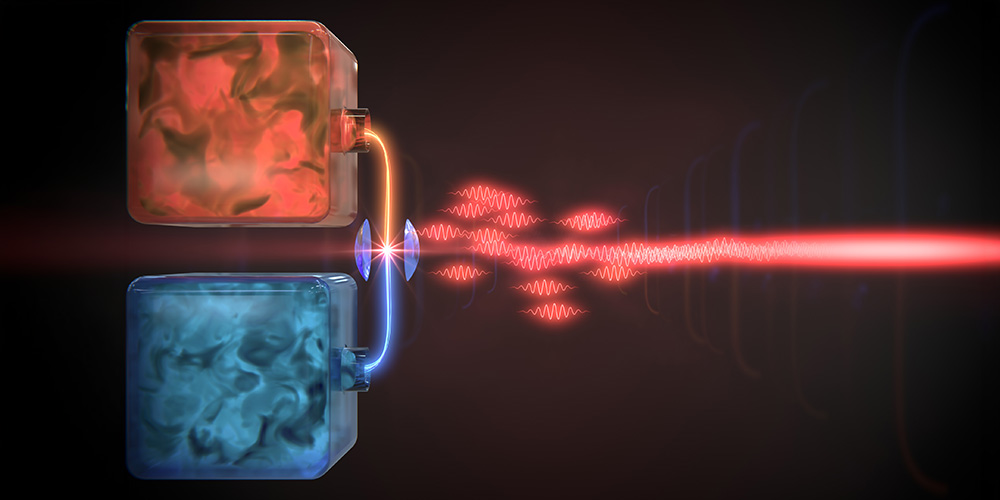
«Our calculations regard the concrete physical model of an atom that is placed in a cavity between two mirrors, where it can absorb and emit light particles», says postdoc Marcelo Janovitch. A laser continuously pumps additional photons into the cavity, while light can escape from the cavity to the outside through the partially reflecting mirrors. «This is a textbook example of a so-called driven-dissipative system that continuously receives energy and simultaneously loses it to the environment», says the researcher. Such a model can be used to study fundamental questions about open quantum systems. In this context the atom acts similarly to a tiny heat engine – or, in this case, a «light engine».
Recently, Potts and his collaborators had already shown that the light particles escaping from the cavity must not generally be regarded as «waste heat» in the thermodynamic treatment. Rather, part of their energy can still be used to perform useful work on another quantum system. In their new paper, the researchers investigated how this distinction between heat and useful energy affects the semi-classical limit.
In the semi-classical limit, the atom in the cavity is still viewed as a quantum system with discrete energy levels, while the light is now taken to be a classical electromagnetic wave such that quantum effects can be neglected. «Treating the light classically makes it much easier to define which part of the energy can be used to perform work and which part is disordered heat», says Janovitch. An important point: this limiting case should be derivable in a consistent way from the quantum-thermodynamical treatment.
Reduced fluctuations as a resource
This is precisely what Janovitch and his colleagues have now been able to show mathematically. Their approach, in which part of the emitted light is counted as work, can be taken to the semi-classical limit without any problems. By contrast, for the conventional method, which regards all the energy escaping from the cavity as heat, this does not work. Moreover, the researchers’ calculations correctly predict how quantum effects lead to a reduction in the fluctuations of the light particles.
These reduced fluctuations, in particular, are interesting for applications in quantum technologies. They make it possible to use heat – which normally leads to disturbances in quantum systems – as a resource for specific purposes. For instance, one can create particular states of light that can be used for particularly precise measurements in quantum metrology.
Original publication
Marcelo Janovitch, Sander Stammbach, Matteo Brunelli, and Patrick P. Potts
Bridging Quantum and Semiclassical Thermodynamics in Cavity QED
Physical Review Letters (2026), doi: 10.1103/y6h7-sx93