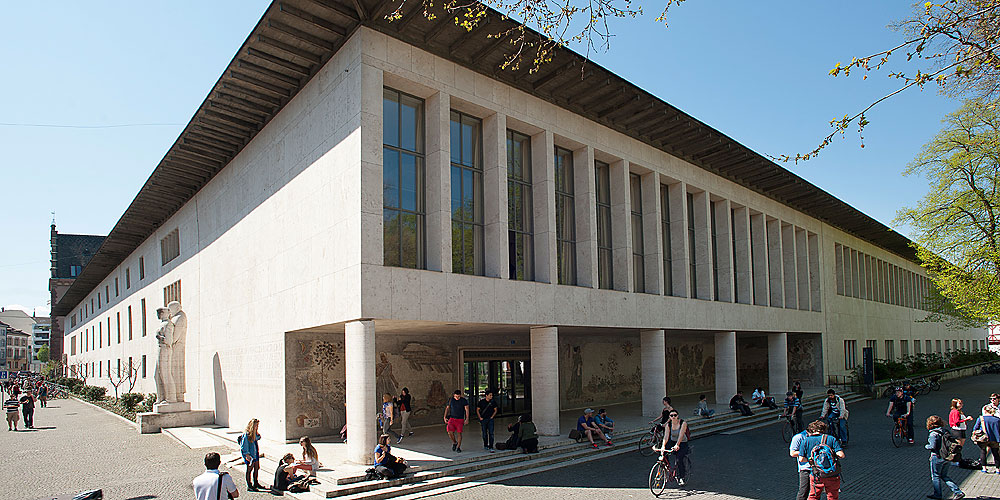
“The year 2026 marks a turning point for our forests.”
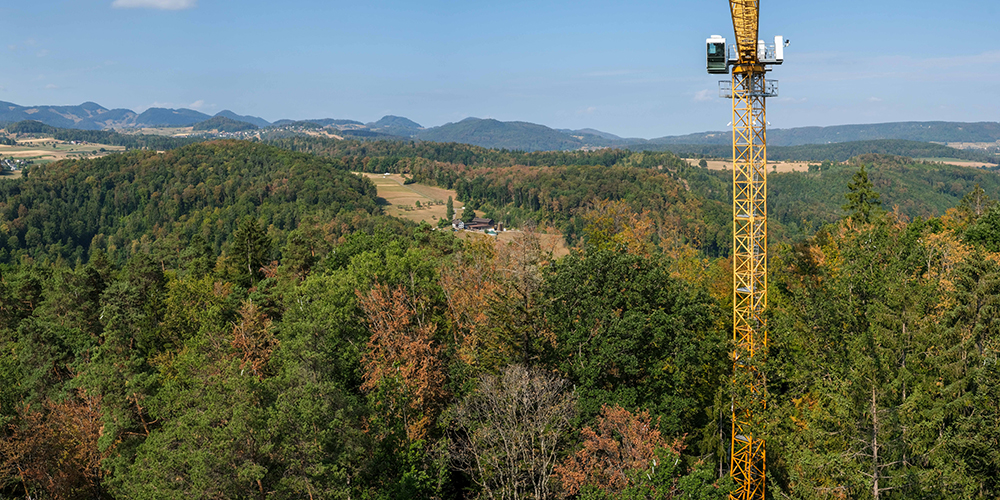
Botany professor Ansgar Kahmen has been studying Switzerland’s forests for years. There has never been a summer as hot and dry as that of 2026 since records began. It is already clear that the forests of northwestern Switzerland are suffering severe damage. The forest of the future will look much different from today, the biologist is convinced.
06 August 2026 | Catherine Weyer
Professor Kahmen, large forest areas have burned in Portugal, Spain and France. Could this also happen in Switzerland during the dry summer of 2026?
Ansgar Kahmen: No, certainly not on that scale. Switzerland lies in a temperate climate zone, where forest fires generally do not play a major role and tend to be the exception. We have seen occasional fires in recent years, but they are usually not as devastating as those in the Mediterranean region.
What caused the forest fires in southern Europe?
Several factors are involved. In Europe, these large fires occur primarily in Mediterranean ecosystems, where forest fires are part of the ecosystems’ natural cycle. The seeds of some Mediterranean plant species, for example, only germinate after a fire. However, humans have intervened in the ecosystem and for a long time tried to prevent larger fires. This allowed more biomass to accumulate as fuel. When a fire does break out, as it has now, it the large amount or accumulated fuel burns with much greater intensity and can cause far more damage. This build-up of combustible biomass is a classic problem that we have frequently seen as a cause of major forest fires in recent years, including those in California and Australia.
What role do the predominant tree species in those regions play?
Most of them are adapted to fire. But for forestry purposes, non-native species have been planted throughout the Mediterranean region for decades, such as eucalyptus species. They, too, are adapted to fire and even need it for their reproduction. The essential oils in their leaves further fuel the flames.
Will nature in southern Europe be able to recover from these fires?
Nature always recovers. The question, however, is how long it will take to restore a landscape that we recognize. It takes 100 years for a pine forest to regrow fully. And the landscape that emerges afterward may not correspond to what we want for tourism, agriculture or our aesthetic preferences.
How are Switzerland’s forests faring in this dry summer?
Not well at all. Northwestern Switzerland is experiencing the driest year since records began. There is not enough water—vast quantities are missing, and they are unlikely to arrive in the foreseeable future.
How much of the current damage is already visible?
We can already see a great deal. A tree does not immediately fall over when it dies. Its roots anchor it and can continue to hold it in place for several years after it has died. At present, however, we are seeing widespread dieback in the outer crown areas throughout the Jura region, especially among beech trees, which are the predominant species. Other species are affected as well. Our experience from our research project in Hölstein, which has been running since 2018, suggests that this damage is mostly irreversible. The year 2026 truly marks a turning point for our forests.
What will the forest look like next spring?
The damage is so severe that we expect many of the trees that have now lost their leaves to die either immediately or over the next few years. The trees are so dried out that they are already shedding leaves they would normally retain until the end of October. For now, this is only a symptom, but it indicates that important tissues in the trees’ crowns have been damaged.
Would a summer thunderstorm bring relief?
No. That amount of rainfall would not be enough for a lasting recovery. On a normal summer day, a forest needs 3 millimeters of water. Extrapolated to one hectare, that amounts to 30,000 liters. This also answers the question of why the forest cannot simply be watered. In addition, if you stand under a tree when it rains, you remain dry at first. A certain amount of rain is therefore needed before it penetrates the canopy and reaches the ground. And because the soil is so severely dried out, the water runs off again immediately. What we would need is two weeks of widespread, continuous rainfall so that the soil becomes moist again and the water deficit is eliminated.
Does that mean the entire forest in the Jura region is dying?
What we are seeing today was something many researchers could not have imagined: such a high frequency of hot and dry summers. In 2003, people still spoke of a ‘once-in-a-millennium summer’. The phenomenon then recurred in 2015, 2018 and 2019, and 2026 will probably surpass them all. The frequency of extremely dry years is therefore increasing dramatically, and many of our native tree species are not adapted to such conditions.
Will the Swiss forest as we know it today disappear?
Our forests will not disappear completely. But in many places, the beech-dominated forests we have today will no longer exist in this form. Since 2018, we have watched this transformation advance at an alarming pace. Native oak species are still better able to cope with today’s temperatures because their root systems extend much deeper. But they, too, will eventually reach their limits. At that point, we will have to consider establishing sub-Mediterranean or even Mediterranean species.
-
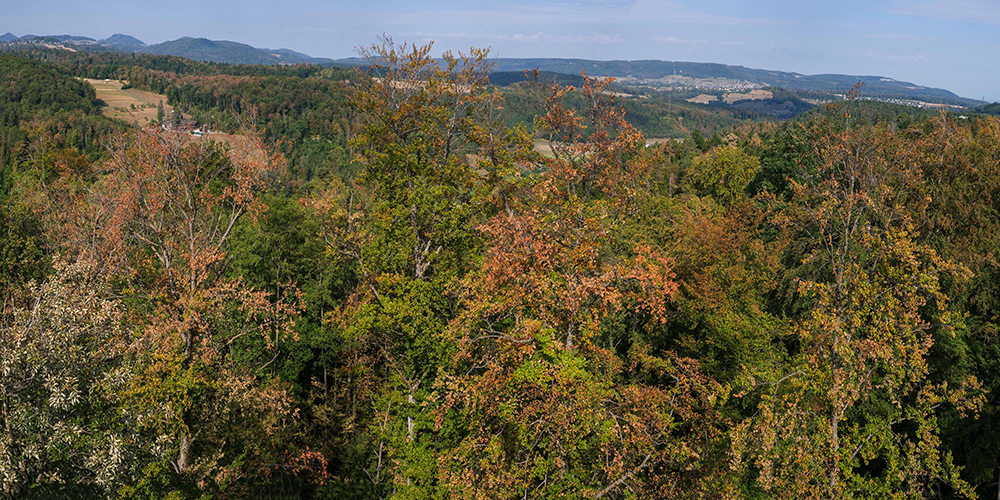 The full extent of the damage will only become apparent in a few years. What is already clear is that many trees did not survive this dry summer (Image: University of Basel, Frederik Baumgarten).link.zoom
Will the large-scale dieback of trees put additional pressure on the climate?
Yes. When trees die and are decomposed by microbes or burned by humans, all the CO₂ that they have absorbed over decades and stored in their biomass is released. If this happens on a large scale, enormous additional quantities of CO₂ enter the atmosphere and drive temperatures even higher. Such self-reinforcing processes can cause climate change to accelerate further.
What challenges do forestry operations now face?
They must decide which tree species are viable for the future. That is far from easy because we are moving beyond the limits of our experience. Planting non-native tree species may also create conflicts with nature conservation, whose aim is, by definition, to preserve what is there. In this case, that would mean a forest dominated mainly by beech trees. But I believe we have to let go of this ideal, because what we are seeing now is truly dramatic.
How will climate change alter our forests?
The forests we grew up with, which have great emotional significance for people in Switzerland and throughout Central Europe, will no longer exist. They will look different because our tree species simply cannot cope with these conditions.
What else can be done to support the forest?
Not much can be done immediately, because the system is too large for rapid and effective intervention. In the long term, the composition of species must adapt to the new climatic conditions. Implementing this is not easy, however, because we are only at the beginning of a climatic transformation. Trees planted today must still be able to cope with the climate prevailing 80 or 100 years from now.