Can brown fat help with weight loss?

Brown adipose tissue responds to cold by burning energy to produce heat. As a natural calorie burner, it could play a key role in tackling obesity. Endocrinologist Professor Matthias Betz of the University of Basel and University Hospital Basel explains why such approaches are still needed even in the age of weight-loss drugs and what challenges remain.
21 September 2026 | Angelika Jacobs
Professor Betz, what is brown fat, and what makes it different from ordinary white fat?
When we talk about body fat, we usually mean white adipose tissue, which primarily stores energy. Brown fat has a different function: it burns energy to generate heat. Until about 15 years ago, scientists thought that brown adipose tissue existed only in infants, who need it to protect themselves from the cold. It was not until 2009 that it was clearly shown to be present in adults as well. Since then, interest in brown adipose tissue has grown substantially. People with active brown fat tend to be slimmer and have a more favorable metabolic profile. Researchers are therefore looking for ways to activate brown adipose tissue—in other words, to increase its energy expenditure—and thereby reduce body weight.
Do we still need approaches like this in the age of weight-loss drugs?
Depending on the weight-loss medication, people can lose 15 to 20 percent of their body weight. But weight loss then tends to plateau, making further reductions difficult. When people eat less and lose weight, their bodies often need less energy as well. The body adapts by reducing its energy expenditure. The mechanisms behind this are still not well understood. A key question therefore remains: How can we increase energy expenditure despite a lower calorie intake? This is where our research on brown adipose tissue comes in.
Where does the research currently stand?
We know from animal studies that certain receptors can be targeted with drugs to activate brown adipose tissue. Receptors are docking sites on cells. In mice, the beta-3 receptor plays a particularly important role. Recent studies in humans, however, have suggested that the beta-2 receptor may be crucial. In the bodybuilding community, substances that activate this receptor are already being used in the hope of reducing body fat. We were the first to scientifically investigate whether activating this receptor can actually increase energy expenditure in human brown adipose tissue.
What exactly did you test?
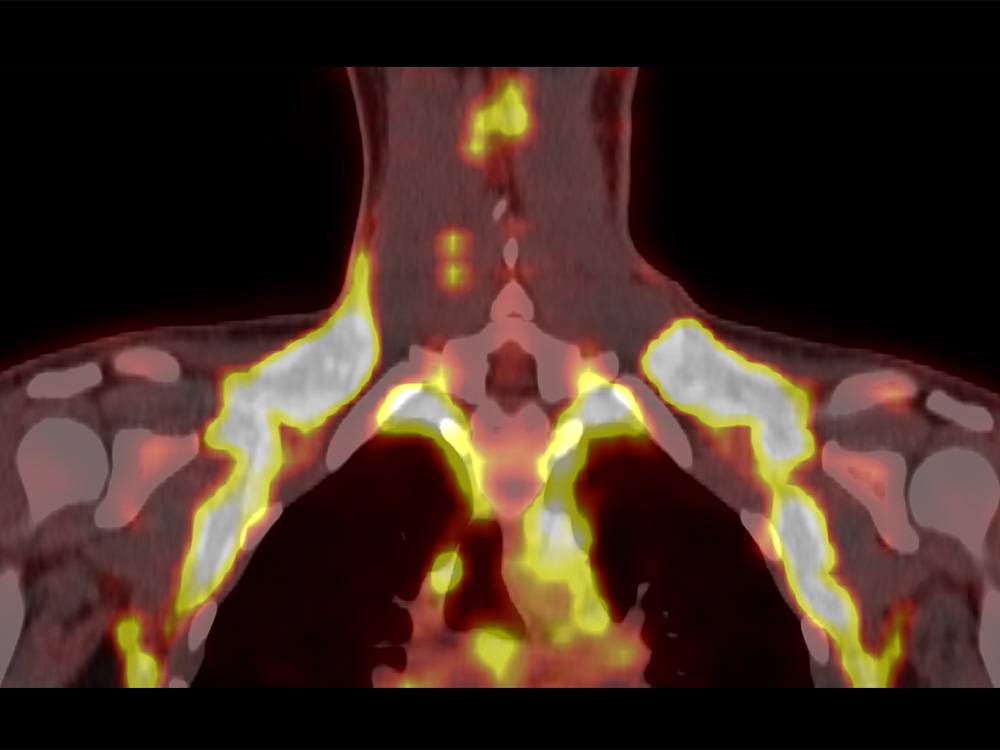
Our main question was whether activating the beta-2 receptor with the drug fenoterol would activate brown fat to a similar extent as its natural trigger, cold. We directly compared the effects of fenoterol and cold in eleven participants. First, we measured changes in the body’s energy expenditure. We also used PET/CT scans to measure how much glucose the brown fat took up – an indication of how active it was.
And what did the experiments show?
Both cold and fenoterol increased energy expenditure. Surprisingly, however, we did not see a comparable activation of brown fat with the drug. In response to cold, brown fat took up significantly more glucose and was clearly activated. This was not the case with fenoterol.
But the drug still increased energy expenditure?
Yes, but we still do not know exactly why. The body can burn energy inefficiently through a range of processes, not just through brown fat. We suspect that lipid cycling may play a role. In this process, fatty acids are repeatedly broken down and rebuilt, which uses energy. Fenoterol may also stimulate other tissues and processes. We do not yet know the exact mechanisms. The key conclusion from our study is that an increase in energy expenditure does not automatically mean that brown fat has been activated.
If cold activates brown adipose tissue, couldn’t we simply increase our energy expenditure by deliberately getting cold?
The problem is that hunger also increases as energy expenditure rises. That is why therapies that suppress appetite and thereby reduce calorie intake are so effective for weight loss. Ideally, we could combine the two: suppress appetite while activating brown fat at the same time. That could help keep energy expenditure as high as possible even when calorie intake falls. However, our results show that activating brown fat in humans is more complex than initially assumed. In our study, stimulating the beta-2 receptor alone was not enough.
What comes next?
We need a better understanding of how brown adipose tissue is regulated. Several receptors may have to work together, or other biological processes may be involved. Basic research is essential here because pharmaceutical companies tend not to focus on this area.
Original publication
Laila Maria Füchtbauer et al.
Beta2-adrenergic stimulation by fenoterol increases energy expenditure without activating human brown adipose tissue
Cell Metabolism (2026), doi: 10.1016/j.cmet.2026.07.012