New therapy allows blind people to detect simple objects
A gene therapy combined with special goggles can help people with a severe inherited retinal disease perceive simple visual information again. An international study involving the Institute of Molecular and Clinical Ophthalmology Basel (IOB) and the University of Basel has now found improvements in visual perception in several participants.
08 October 2026
Finding a doorway, following a line or detecting an object on a table: For people who are nearly or completely blind due to advanced retinitis pigmentosa, such tasks can become impossible. Retinitis pigmentosa is a group of inherited retinal diseases in which the light-sensing cells of the retina gradually degenerate.
An international research team has tested a therapy in a group of ten patients. The study was led by Professor José-Alain Sahel from the University of Pittsburgh and Professor Botond Roska from IOB and the University of Basel. GenSight Biologics and other international research partners were also involved.
In 2021, the same research team reported that a single blind patient was able to perceive objects again using the approach. The new study, published in the New England Journal of Medicine, now shows that similar improvements can also be observed in other patients.
New light sensors for the retina
The approach combines gene therapy with special goggles. The gene therapy modifies certain nerve cells in the retina that remain intact despite the disease. Normally, these so-called retinal ganglion cells are not sensitive to light themselves. Instead, they transmit signals from the retina’s light-sensing cells to the optic nerve.
The gene therapy provides the ganglion cells with the genetic instructions for a light-sensitive protein. This enables the cells to respond to light themselves. This approach is known as optogenetics - a method for which three researchers were recently awarded the 2026 Nobel Prize in Medicine.
The accompanying goggles use a camera to capture the surroundings and convert changes in the visual scene into light signals that activate the modified ganglion cells.
Visual perception improved in several participants
The primary aim of the study was to assess the safety of the treatment. The researchers also investigated whether there were signs of improved visual function.
Overall, the treatment was well tolerated. Most eye-related adverse events were mild or moderate. A temporary blockage of blood flow in the retina immediately after the injection was classified as severe. It resolved completely within minutes after treatment.
With the special goggles, the treated eye became more sensitive to light in seven of the ten participants following gene therapy. In six of them, the improvement reached the predefined threshold for a clinically meaningful change.
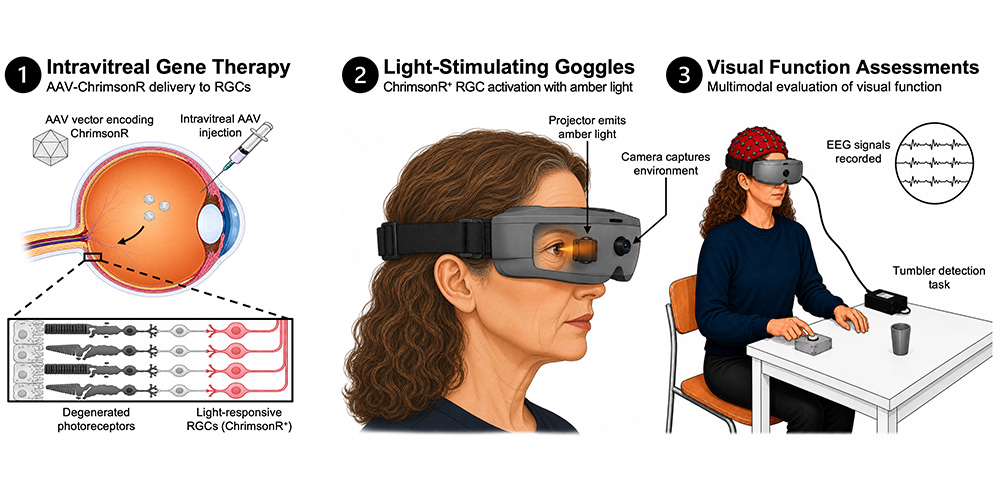
Eight participants also completed a range of tests in which they had to detect objects or determine their location, for example. Four showed consistent improvements across several of these tests. However, the results varied considerably between individuals.
One advantage of the new treatment is that it does not target a specific genetic defect. Changes in more than 100 different genes can cause retinitis pigmentosa. Treatments that address the genetic cause directly therefore need to be tailored to the particular form of the disease. Optogenetic therapy sidesteps this problem by turning surviving ganglion cells into new light sensors.
The brain has to learn to use the new signals
The treatment alone is not enough. Patients have to learn how to use the unfamiliar visual signals. In the study, participants who had more training with the goggles tended to perform better in the tests. Training could therefore become an important part of this type of therapy.
The method is still far from restoring normal sight. Overall, the improvements were modest: participants were able to detect, distinguish or locate some objects, but the treatment did not restore high-resolution vision.
“It was encouraging to see that our treatment was safe and could restore some visual function,” says Botond Roska. “Our next major challenge is to achieve high-resolution vision that would allow patients to recognize faces.”
Nevertheless, the findings show that even in people with very advanced retinitis pigmentosa, surviving nerve cells in the retina can be used to convey visual information. The researchers now aim to refine the approach to provide more detailed visual information that can be used more effectively in everyday life.
This news is based on a press release by the IOB.
Original publication
Jose-Alain Sahel et al.
Optogenetic Therapy for Restoring Aspects of Visual Function
New England Journal of Medicine (2026), doi: 10.1056/NEJMoa2602215