Additional income: transparency pays off for politicians
When parliamentarians disclose their additional income from lobbying work, they gain more trust from the electorate. This was demonstrated for the first time by researchers from the University of Basel. Even members of parliament who receive very large financial contributions from their vested interests benefit from greater transparency.
02 December 2025 | Lara Uebelhart
In Switzerland, the extent to which national politicians must disclose their additional income is regulated by law: apart from having to provide information on whether or not their activities in addition to their mandate are paid, they are not required to disclose any details about their income. “In Switzerland, at the moment it is largely a black box as to how much money our elected representatives actually receive,” emphasizes political scientist Dr. Oliver Huwyler.
Since 1985, Swiss parliamentarians have been obliged to disclose their vested interests. As Huwyler explains, these are links to organizations that represent specific interests, either those of society as a whole or those of more narrowly defined groups. “Politicians become involved in these organizations by formally assuming a role. Usually, these are positions on boards, committees or advisory boards, which may be paid or unpaid.”
These ties are crucial for the actions of members of parliament, as it has been proven that their vested interests reflect the issues with which they engage. The question is: how does this information affect voters in concrete terms? And what does this mean for the future of transparency regulations in democracy?
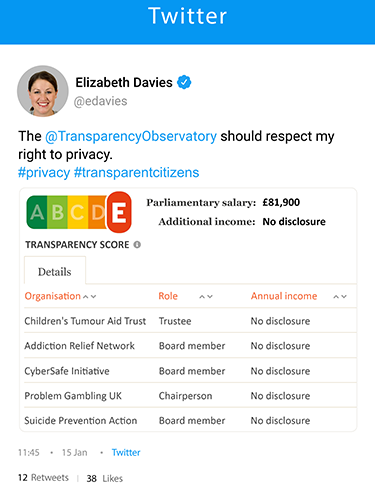
Twitter posts by fictious politicians were rated
In a cross-border study, Oliver Huwyler and Professor Stefanie Bailer from the University of Basel worked with Professor Nathalie Giger from the University of Geneva to investigate the effect that transparency surrounding additional income and vested interests has on voters. In 2021, the researchers surveyed around 14,100 people from seven European countries: Belgium, France, Germany, the Netherlands, Poland, Switzerland and the UK.
In the survey, participants rated Twitter posts by fictitious politicians. The differences between the invented profiles lay in how many and which vested interests they had, and how transparently they disclosed their income. In addition, the amount of financial contributions varied from 0% to 150% of the salary from their main job as a member of parliament.
Transparency as a sign of quality, despite high additional income
The results of the study show that transparency is viewed positively by all voters, regardless of political orientation. However, people with higher incomes and those who tend to be more left-leaning place more value in transparency than the average. Nevertheless, all politicians would still benefit from greater openness. “Transparency helps everyone, but not everyone equally,” says Huwyler. Bailer adds: “The measurable success of greater transparency goes beyond party labels.”
The cross-country comparison also shows that the trust-building effect of transparency is a general phenomenon that manifests itself independently of the country. According to the researchers, the specific mechanism behind this is not yet entirely clear. However, they suspect that voters perceive the disclosure of vested interests as a sign of quality. And that’s why they give their preferred candidate their vote at the ballot box.
One might assume that large additional incomes in particular could be detrimental to politicians. However, the study shows that respondents still prefer parliamentarians who are transparent about their large additional income over someone who does not disclose their earnings at all. Even if the additional income is 1.5 times the salary for their elected position, it would still be better to be transparent about it than to conceal it.
Political trust is declining, dissatisfaction is rising
Although the data is from 2021, the results are still relevant, says Huwyler: “Transparency regulations are changing very slowly.” Stefanie Bailer adds: “Switzerland is one of the most opaque countries in Europe, because it is not clear how much money members of parliament receive and where it comes from.” The level of transparency that is currently required allows for many loopholes and creates uncertainty.
This situation is particularly explosive given that political trust is demonstrably declining. “We are seeing an increasing number of violent acts against politicians, including in Switzerland,” says Bailer. “Dissatisfaction with democracy is on the rise.” This is a direct consequence of distrust. “If vested interests and income are not transparent, the electorate will still make assumptions that may prove even worse.”
One thing is clear: voters want to be able to trust that their elected representatives are working to promote their interests and needs and not primarily the interests of certain organizations. Nevertheless, according to Bailer, the argument that citizens are not interested in transparency is often used in parliamentary debates. The study clearly refutes this assumption and is thereby the first empirical study to provide proof of the positive effect of transparency.
The results of the study should therefore provide an incentive for politicians. Bailer says: “The hope is that our results will motivate parliamentarians to be transparent themselves or to advocate for greater disclosure. We are giving politicians a scientific argument in favor of transparency because it makes a difference.”
Original publication
Oliver Huwyler, Stefanie Bailer and Nathalie Giger
Transparency matters: The positive effect of politicians’ side income disclosure on voters’ perceptions
European Journal of Political Research, 1–18 (2025), doi: 10.1017/S1475676525100303
Further information
Prof. Dr. Stefanie Bailer, University of Basel, Department of Social Sciences, tel. +41 61 207 13 81, email: stefanie.bailer@unibas.ch