

“The U.N. is being put to the test like never before.”
Interview: Samuel Schlaefli*Iran, Venezuela, Gaza, Ukraine: International law is being violated all over the world. We talk to Andreas Müller, an expert on international law, about the past and present of a fragile but enduring concept.
UNI NOVA: Professor Müller, the wars in Gaza and Ukraine, the kidnapping of the president in Venezuela, the USA’s claims to Greenland and, since the end of February, the attack on Iran — would we be mistaken to say that there never been so many violations of international law as there are today?
Andreas Müller: It depends on the period under consideration. Looking back, we can repeatedly see examples where there has been massive upheaval of the international order — that’s not exactly unique. That being said, we’re living in strange times, particularly with regard to the United States, which — under the Trump administration — is turning away from the international legal order. For the USA, the U.N. also previously served as a way to secure European alignment and advance its own geopolitical interests. By shifting away from this order, the Trump administration is calling the transatlantic relationship into question. That’s why this distress at the failure to comply with international law is also a specific Central and Western European experience.
What do you mean by that?
When people in Latin America or Africa look back on the past decades and the compliance — or noncompliance — with international law, the experience is quite different. For them, the post-1945 international order is also a post-colonial project that has served to entrench many global injustices. International law has also been used to legitimize covert military operations or to provoke civil wars in Latin America and Africa.
Which specific events are you thinking of?
Examples include the intervention and forced change of government on the Caribbean island of Grenada by the USA in 1983, and the invasion of Panama in 1989. The latter was similar to the illegal arrest of Nicolás Maduro in Venezuela at the start of this year in violation of international law. Nevertheless, something has fundamentally changed: Previously, the USA justified its actions with arguments based on international law. In 2003, for example, the U.S. government tried to justify the attack on Iraq, which violated international law, with fake photos of facilities for producing weapons of mass destruction. Presenting its own actions as compliant with international law has always been important to the USA — and to Russia as well. That has changed.
Can you explain that?
It is remarkable how President Putin justified the aggression against Ukraine in a speech in February 2022 with arguments based on international law. He said the action was self-defense against the expansion of NATO and a humanitarian intervention to protect the Russian minority in Ukrainian territories. Of course, this was far-fetched, but it shows that the great powers go to great lengths to maintain the appearance of acting in accordance with international law. That no longer seems to be the case. When the USA invaded Venezuela in January, it only attempted to legally legitimize its actions retrospectively and half-heartedly. In Iran, the USA again brought up arguments based on international law, such as the need for self-defense, but these arguments are not tenable.
The U.N. Charter system on international law has existed for over 80 years. How did it come about and what promise was it associated with at the time?
Today’s international law dates back to 1945, when the U.N. Charter was concluded in full knowledge of the impact of World War II on millions of people — namely, death, torture and expulsion. It formed the basis for the Universal Declaration of Human Rights and the Genocide Convention of 1948, as well as the Geneva Conventions a year later. At that time, there was a strong awareness of “never again,” and that an order was needed to stabilize the geopolitical system and prevent war and mass extermination.
How well did that work out?
The good intentions were immediately foiled by the arms race between the USA and the Soviet Union. This was followed in 1950 by the Korean War with millions of casualties. In that respect, the international order was never as stable as it is currently portrayed in some media. Nevertheless, the long period of the Cold War can ultimately be seen as a success story for multilateralism. The Cuban Missile Crisis, with the real threat of a nuclear war between the USA and Russia, ended well. International law had a civilizing and calming impact.
The USA has drastically cut its contributions to the U.N. since 2017 and has withdrawn from institutions such as the WHO, UNESCO and the U.N. Framework Convention on Climate Change. Will the U.N. survive these deliberate attempts to weaken it?
I view this objectively and struggle with the claim that the U.N. is obsolete or finished. If you look more closely at these withdrawals, some of them are more symbolic. Not even the Trump administration has so far contemplated withdrawing from the U.N. and consequently from the Security Council. But the U.N. is certainly under threat and faces a unique challenge. At the same time, this international legal order is too resilient and adaptable for me to join in the lament just yet.
Now, however, Donald Trump has essentially founded an alternative organization with his “Board of Peace.” How much of a threat is this board to the U.N.?
Initially, the “Board of Peace” was intended to play a role solely in connection with the Gaza peace plan. The Trump administration even consulted the U.N., which surprised me. They obtained a resolution of the U.N. Security Council and had to negotiate with China and Russia and make certain concessions to do so. But now the board is suddenly being presented as a kind of counter-U.N. This aligns with the discourse fueled by the U.S. administration that the U.N. is old, weak and tired. I don’t believe the “Board of Peace” will actually come to anything. But I’m concerned that some states are increasingly turning away from the U.N., preferring to rely on China or join other continental alliances. If enough damage is done, the system may no longer be able to recover.
China has been increasingly involved in the U.N. for years. Could it take the place of the USA?
There’s a certain irony in the fact that today, in comparison with Russia and the USA, no other world power is as loyal to the U.N. as China. The country is thereby gaining credit in many parts of the world. For example, China has clearly condemned the USA’s violation of international law in Venezuela, whereas the Europeans have not, or only in a few cases. This pattern is now repeating itself with Iran.
Recently, there have been renewed accusations that the U.N. applies double standards depending on the conflict. Israel’s attacks on the civilian population in Gaza and Russia’s war of aggression against Ukraine were violations of international law. Yet the international responses differed widely. What is your assessment?
The criticism is certainly justified. Following the attack on Ukraine, the USA and the EU wasted no time in imposing far-reaching sanctions on Russia, and Switzerland joined them. Nothing of the sort happened in the case of Gaza, even though there was clear evidence of war crimes and crimes against humanity. Here, we certainly do see different standards being applied. If the EU now claims to defend international law and wants to protect the multilateral order, many people rightly ask themselves: How does that add up?
Is this a call for more consistency in the defense of international law — particularly on the part of Europe?
Yes, because it now depends on whether the EU and Switzerland take their constitutional commitments to international law seriously and actually stand up for it. Europe is unfairly downplayed — or is downplaying its own importance. Europe is a significant economic player on the global scale, and many states align themselves more with Europe than with the USA when it comes to international law and multilateralism. In Europe, however, we’re unfortunately seeing a strategy of preemptive shirking when it comes to the USA. Everyone is happy as long as it’s someone else in the firing line. That’s very shortsighted, because the global order must be defended whenever it’s challenged.
* The interview was conducted end of February 2026.
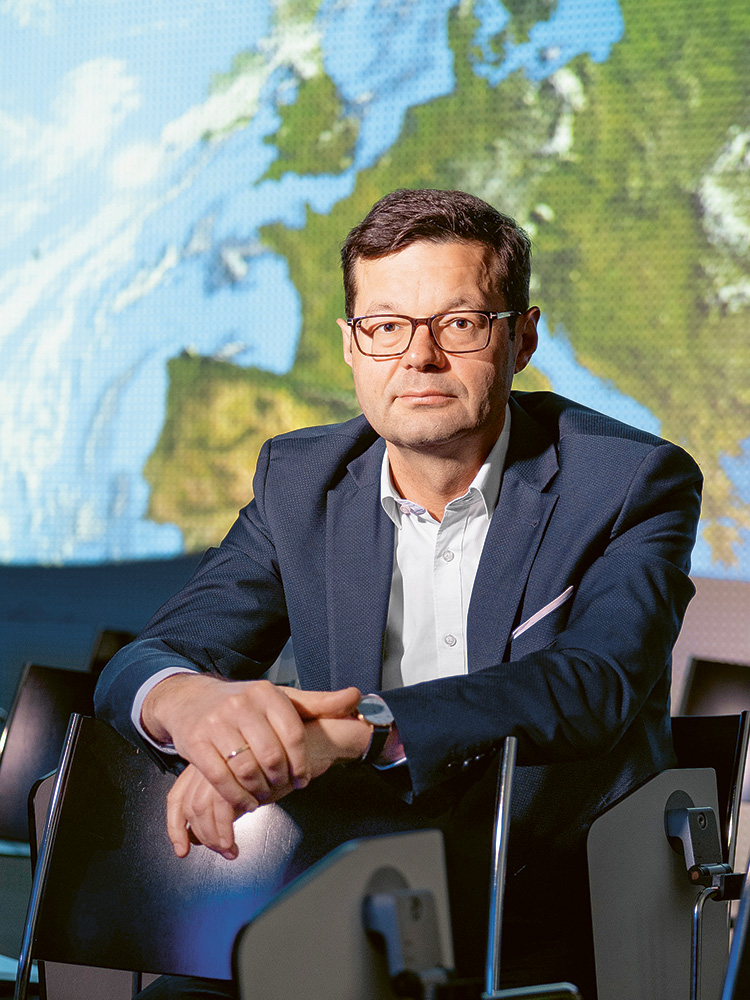
Andreas Müller has been Professor of European Law, International Law and Human Rights at the Faculty of Law of the University of Basel since 2023. He studied at the University of Innsbruck in Austria and at Yale Law School in the USA. In 2009, he spent a year working at the International Court of Justice in the Hague.
More articles in this issue of UNI NOVA (May 2026).