New record: Laser cuts bone deeper than before
Lasers cut precisely and without contact – ideal for surgery. The problem is that, in hard tissues such as bone, they are too slow and do not cut deep enough. Researchers at the University of Basel have now demonstrated a way to cut much deeper and faster with a surgical laser than with previous laser systems.
26 February 2026 | Angelika Jacobs
The saw, chisel and drill are tried-and-true tools in bone surgery. In the future, lasers could be added to this toolbox, especially when it comes to very precise cuts. Lasers do not exert any mechanical pressure, meaning they can reduce the risk of microcracks and enable more specialized cuts. This would make it easier to insert joint implants, for example, including custom-made, 3D-printed implants.
Lasers are already used for soft tissue. In the case of bone, however, cuts were previously only possible up to a depth of 2 to 3 centimeters, far too shallow for joint implants, for example. One reason for the insufficient cutting performance is the shape of the laser beam.
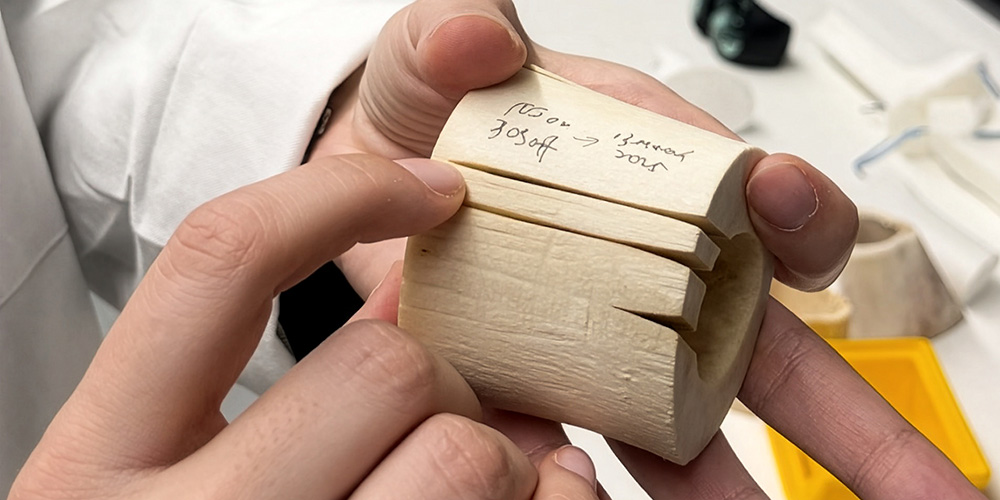
Researchers led by Dr. Ferda Canbaz from the Department of Biomedical Engineering at the University of Basel have now reported a breakthrough in the journal Scientific Reports: They achieved cuts down to a depth of 4.5 centimeters by using a different profile of the laser beam, i.e. a different distribution of the energy in the beam. This enabled them to remove the bone material more efficiently and faster.
More even energy distribution
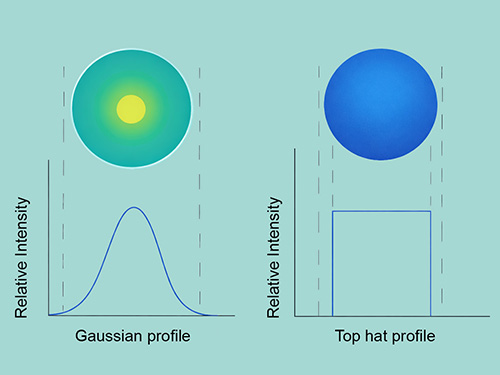
“Increasing the energy of the laser beam would not be a good solution. This could char the bone and have a negative impact on the healing process,” explains Ferda Canbaz. “That’s why we changed the shape of the laser, or rather its profile.”
With the usual profile, the beam is strongest in the center and becomes weaker toward the edge. This is similar to the beam of a flashlight, which is brightest in the center and runs outward. The intensity resembles a Gaussian curve with a rounded tip in the middle. In the new profile the tip is capped, enabling the energy of the laser beam to be distributed more evenly across the entire surface before dropping abruptly at the edge, hence the name “top hat”. “Because the energy is transmitted more evenly, the laser cuts more efficiently and faster,” says doctoral student and lead author Mingyi Liu.
The team tested the two laser profiles on bovine bones. The bone was cleaned and cooled with compressed air and water to prevent heat damage and keep the cut clear. The trials showed that, while the laser with the usual Gaussian distribution cut only about 2.6 centimeters deep, the one with the new top hat profile reached 4.4 centimeters.
Efficiency even in greater depth
“A key factor for cutting efficiency is the fact that with the conventional laser profile, the walls of the cut absorb part of the energy. At a certain depth, the energy at the bottom of the cut is not sufficient to cut any deeper.
The top hat profile overcomes this problem because the energy in the beam is distributed differently and thus isn’t consumed by the walls of the cut.”
Major progress in cutting depth
The researchers are now working on further optimizing the cutting depth and speed of their laser. The laser-blade is still significantly slower than a metal one: in one second, it can remove around 0.4 cubic millimeters, while a mechanical saw can remove 11 cubic millimeters, more than 20 times as much. This means that the laser is still too slow, but it approaches the required depth for the first time.
“As part of the next steps, we will also need to investigate how we can adapt the system to the more complex situation in the body. There, it is also about protecting the surrounding tissue,” explains Canbaz.
The work of the research team is part of the MIRACLEII project, which develops innovative technologies for bone surgery and is funded by the Werner Siemens Foundation. The developments are involved in the first step of the Innosuisse “Laser-Blade” project, a collaboration with medical technology company Smith&Nephew.
Images for download can be found at the media database.
Original publication
Mingyi Liu, Arsham Hamidi, Dunia Blaser, Darren Wilson, Kenneth Garcia, Niklaus F. Friederich, Georg Rauter, Philippe C. Cattin, and Ferda Canbaz
Influence of laser beam intensity profile on deep bone ablation in laser osteotomy
Scientific Reports (2026), doi: 10.1038/s41598-026-37117-6
Further information
Dr. Ferda Canbaz, University of Basel, Department of Biomedical Engineering, email: ferda.canbaz@unibas.ch, phone: +41 61 207 54 67 (available from 9.30am on 26 February 2026)