Sleeping instead of eating: How the gut influences behavior
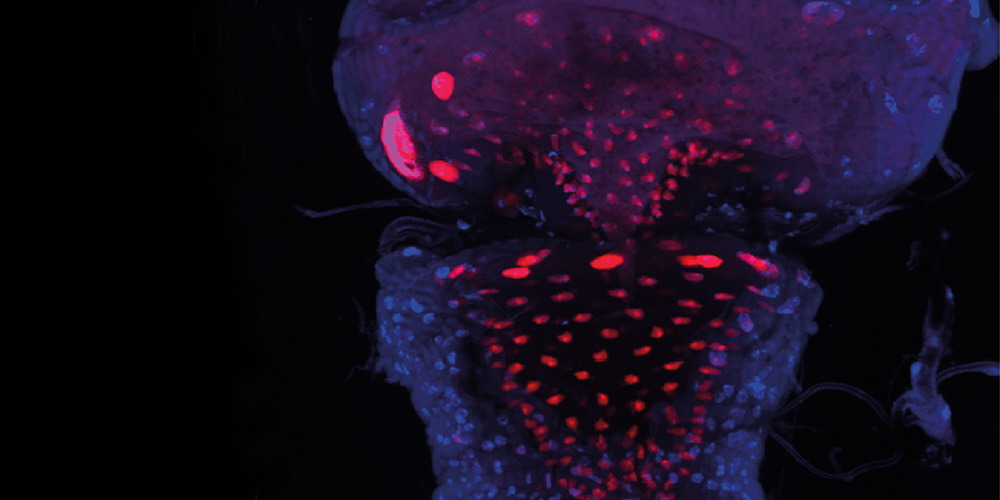
The gut does much more than just digest food. Researchers at the University of Basel have now discovered a surprising link between gut function, feeding, and sleep in fruit flies. Their study adds to growing evidence that the gut communicates with the brain and can influence behavior.
09 June 2026 | Katrin Bühler
The first hours of life are critical for the survival and thriving of animals. Two key steps occur during this time: the excretion of metabolic waste – known as meconium – and the beginning of independent feeding. Until recently, it was unclear how these two processes are connected and how the gut might influence eating and sleeping behavior. Understanding these links is of broad interest and also intensively investigated in humans because gut-brain communication is increasingly implicated in human health and disease.
Genetic defect causes intestinal blockage
The fruit fly Drosophila melanogaster faces the same challenge after hatching. Professor Anissa Kempf’s team at the Biozentrum, University of Basel, found that timing matters. They discovered that young flies only start feeding after partial meconium elimination. However, flies suffering from intestinal obstruction avoid food, sleep unusually long, and die prematurely. These findings suggest that gut function directly affects eating and sleeping behavior.
The gut problem can be traced back to a gene that plays an important role in fruit fly development. As early as 1914, scientists discovered that flies with a defect in the apterous gene fail to develop wings. They also noticed back then that these flies die young.
“We have now identified the cause of early death and resolved a question that has puzzled researchers for more than a century,” says Kempf. “The gene defect not only affects wing development but also proper hindgut development, leading to intestinal blockage.”
Intestinal blockage makes flies lethargic
Due to the blockage, the flies cannot expel their meconium after hatching. Over time, they become increasingly lethargic and sleepy, and they don’t feed even though they are hungry.
“We think that the flies sleep more in order to conserve energy and thus survive longer,” explains Dr. Cindy Reinger, first author of the study. “While sleeping, flies also move their proboscis rhythmically, which may help stimulate gut motility. Perhaps this is a desperate attempt to get rid of the meconium.”
The researchers also discovered the cause of the fatal intestinal blockage. “In healthy flies, four so-called rectal papillae form during early development. These structures are essential for water reabsorption to minimize water loss,” says Reinger. “Instead of developing four normal papillae, the mutant flies form a plug-like structure in the hindgut that completely blocks the intestine. We named it the Reinger’s knot.”
Parallels with humans
The study clearly demonstrates that gut function is linked to feeding, sleep and ultimately survival. The research also brings up new questions: How does the gut communicate with the brain? How does the intestine regulate sleep? And how does the body know when to start eating?
Many of the symptoms seen in fruit flies resemble intestinal obstruction in humans, including constipation, loss of appetite, lethargy, swelling of the gut, and tissue damage that can lead to intestinal rupture. The study suggests that gut signals may trigger some of these symptoms.
Because fruit flies share many biological processes with humans, they provide a powerful model for investigating the mechanisms behind digestive disorders and gut-brain communication.
Original publication
Cindy Reinger et al.
Intestinal obstruction impairs feeding and promotes sleep in Drosophila melanogaster
Science Advances (2026), doi: 10.1126/sciadv.ady2183