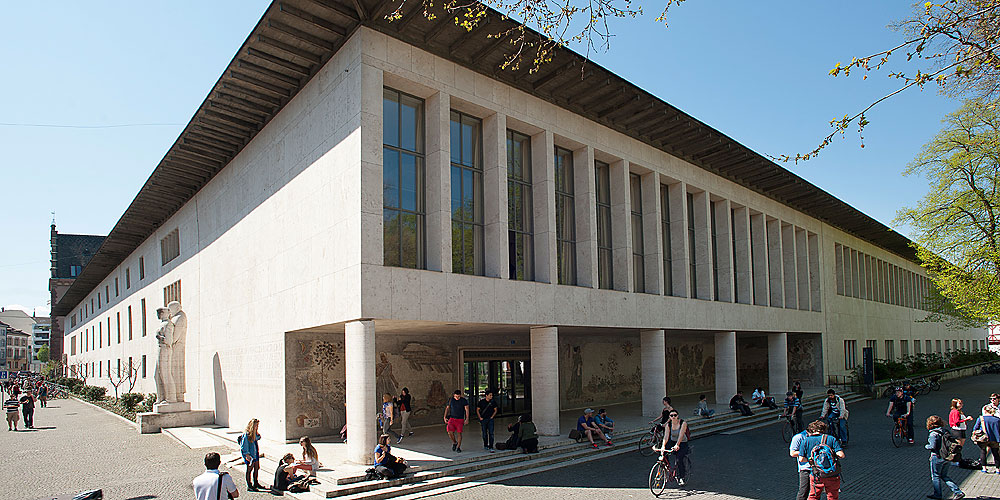
In Focus: David Koch wants to better predict who will benefit from spinal surgery
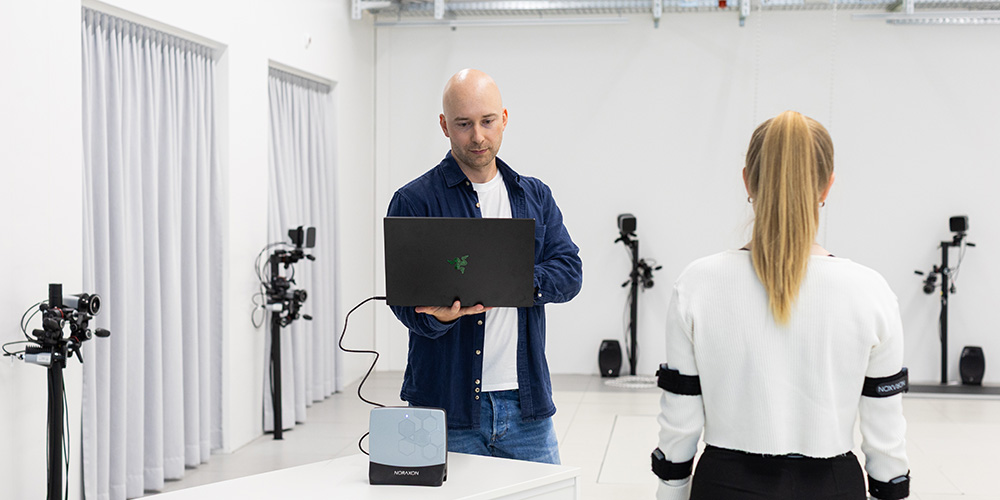
His original plan was to become a PE teacher. However, when David Koch had to resubmit his seminar paper, he used the waiting time to complete a research internship. There, he found his field through a combination of movement science, biomechanics and clinical practice.
09 July 2026 | Angelika Jacobs
“My defense was at the beginning of May,” says David Koch. You can sense the relief in the air during this meeting, which takes place about a month later. The strain of the final stages of his PhD has lifted.
Before attending a study visit at the university hospital this morning, the newly qualified movement scientist takes the time for a chat in the hospital’s bistro. Over a cup of coffee, he talks informally in his local dialect about the topic he worked on in his dissertation and is still working on as a postdoc in the Department of Biomedical Engineering: a narrowing of the lower spine that affects around 10% of the population – especially those over the age of 65. Statistically, around 180,000 people in Switzerland live with the effects of lumbar spinal stenosis. There are no official diagnosis figures, but given the aging population, this number is likely to rise further.
Who could benefit from surgery?
Age-related wear and tear causes the spinal canal to narrow, leaving too little space for the nerves. This can lead to pain, tingling and even numbness, as well as an unsteady gait. Many of those affected can only walk short distances and, depending on the severity of the narrowing, experience a significant reduction in their quality of life.
The severity of the symptoms often depends on posture. This is why patients instinctively avoid positions that cause pain and adopt alternative postures instead. “Our studies show that a large part of this compensation takes place at the pelvis,” David Koch explains. “Many people also walk hunched over.” In the long run, such poor posture has an impact on the muscles.
In most cases, surgery to widen the narrowed canal helps. “But one in four people does not benefit measurably from the operation,” Koch says. “Through our study, we are trying to find out how we can better predict the success of the treatment.”
Bad training habits as a teenager
When you hear him talk about the clinical aspects of his work, you would think you’re sitting opposite a doctor. This makes it all the more surprising that he studied sports science at the University of Basel and originally wanted to become a teacher.
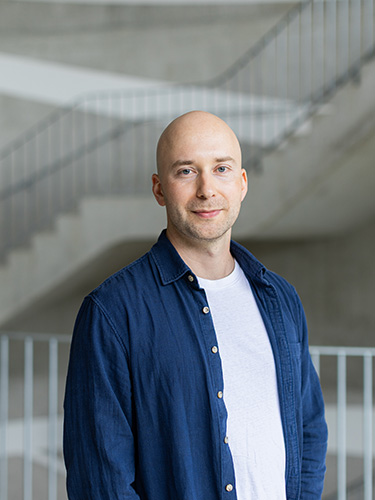
“I started strength training as a teenager.” With a touch of self-deprecating humor, the 31-year-old recounts how he prioritized the wrong things back then. “Like many young people, I only trained my chest muscles, for example, but neglected my back.” This eventually led to problems with his shoulder. “A coach then helped me train more holistically – with kettlebells, barbells and my own body weight.”
He became fascinated by the principles behind this kind of functional strength training, which focuses not on individual muscles but on everyday movement patterns, and has the potential to correct muscle imbalances. Studying sports science with the aim of becoming a PE teacher seemed the obvious choice, he recalls.
Minor setback, major impact
The fact that he is not standing in front of a class today is down to a botched seminar paper and a stroke of luck. “I had six months to wait before I could resubmit the work, and I wanted to put that time to good use,” says Koch. His roommate at the time arranged an internship for him in the “Functional Biomechanics” research group, where that same roommate was currently working on his doctorate. “It involved questions relating to the wear and tear of joints and articular cartilage,” Koch explains.
He gained insight into research that produces findings to help people. That was the moment when something clicked for him. “The idea of being able to contribute to improving patient treatment really motivated me and was very close to my heart,” he says emphatically.
This motivation also has family roots: his mother worked in nursing and his sister also started out on the same career path. For him, movement science and biomechanics are areas in which his desire to help others can be combined with his passion for exercise and sport.
Striking a balance through exercise
As in the early days of choosing this career, David Koch still plays sport today during his free time. For his milestone birthday last year, friends and family gave him a gravel bike, he says with obvious delight. Cycling provides him with a welcome break from his intensive research work.
After a 10-year break, he has also taken up handball again, a sport he had previously played for a long time. For him, it’s a hobby that combines the competitive, the playful and the social.
Off to Canada
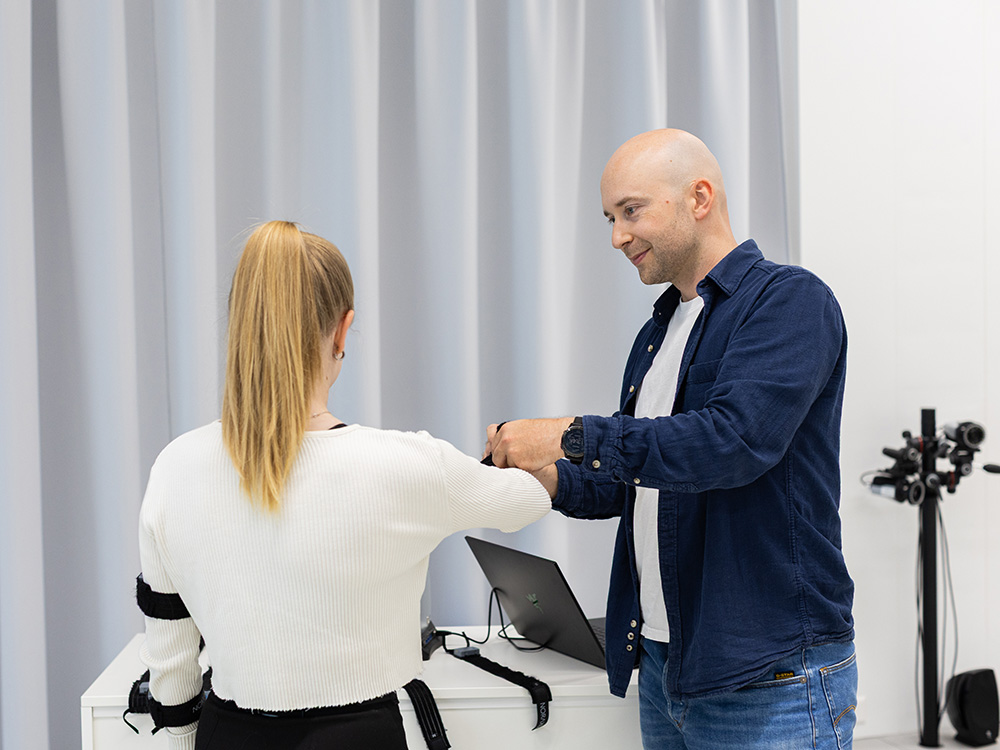
The project on which his dissertation was based has just been extended by three years thanks to new research funding. He will continue working on this topic as a postdoc, but first he is due to undertake a research stay in Canada. Over the next few months, he will be investigating misalignments of the knee joint, which can also be corrected through surgery. The focus is on the distribution of pressure within the knee joint. The common factors remain biomechanics and the aim of improving patient treatment.
It is very important to him that the findings from his various projects benefit those affected. That is why he can also imagine working more closely with patients in the future.
As he says his goodbyes to set off on his study visit at the university hospital, his former career aspirations briefly come to the fore. Today, the study visit is being carried out by a team of students whom he is accompanying. “I really enjoy working with them,” he says. “It’s fascinating to see how they all approach issues differently and solve problems in completely different ways.” So he has become a bit of a teacher after all.
In Focus: the University of Basel summer series
The In Focus series showcases young researchers who play an important role in advancing the university’s international reputation. Over the course of several weeks, we will profile academics from various fields – a small representative sample of the more than 3,000 doctoral students and postdoctoral researchers at the University of Basel.