In Focus: Stavros Stagakis measures Basel’s CO2 emissions
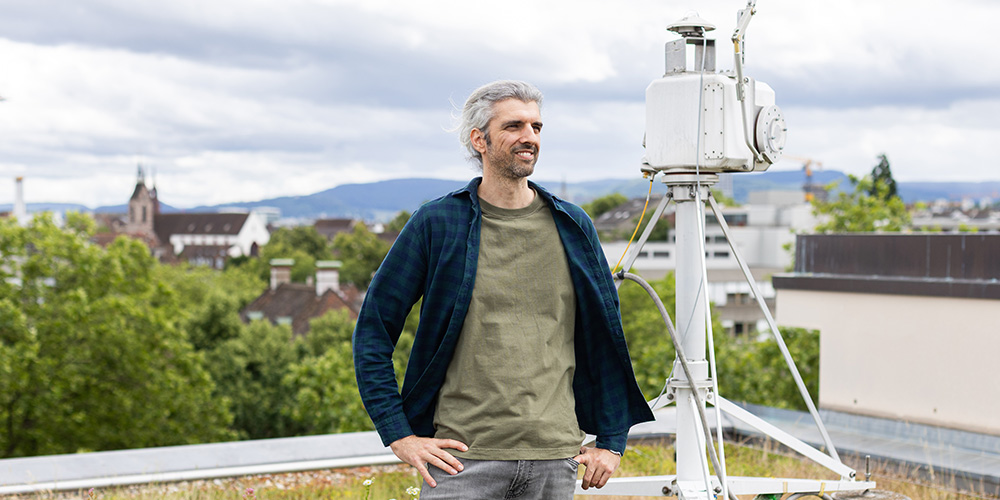
Few would dispute that greenhouse gas emissions need to be reduced to slow down climate change. But how much CO2 do cities actually emit today? Postdoctoral researcher Stavros Stagakis from the Department of Environmental Sciences is exploring ways to measure these emissions.
28 July 2026 | Michelle Isler
Basel wants to reduce its greenhouse gas emissions to net zero by 2037. Many cities around the world have similar targets. And with good reason: according to estimates by the Intergovernmental Panel on Climate Change, cities are responsible for more than 70 percent of global CO2 emissions. Until now, estimates of greenhouse gas emissions from individual cities have relied on calculations based on numerous assumptions. Environmental scientist Stavros Stagakis is taking a different approach: monitoring based on real-time data.
This is challenging. “When measuring CO2 exchange between a forest and the atmosphere, you choose a section of forest that is as homogeneous as possible, with uniform vegetation,” the researcher explains. “In cities, conditions are never homogeneous.” This complexity has fascinated him throughout his research career.
The world’s longest urban measurement record
Stagakis earned a bachelor’s degree in applied biology from the University of Ioannina in the mountainous northwest of Greece. He stayed there for his PhD, specializing in remote sensing and climate-ecosystem interactions.
After further research positions in Greece and Spain, he moved to Basel. What drew him here was a CO2 monitoring station on the roof of the Department of Environmental Sciences, its gray metal structure visible from Klingelbergstrasse. CO2 emissions have been recorded here continuously since 2004, making it the world’s longest urban measurement record.
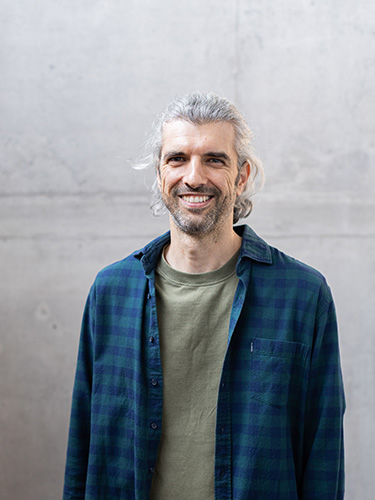
Now Stagakis — wearing an olive-green T-shirt and a broad smile, with gray threaded through his beard and hair — sits in a conference room a few floors below the station and recalls his early days in Basel. In 2019, a Marie Curie Grant enabled him to carry out a two-year project in Basel to study the CO2 measurement approach here. His goal was to make similar methods available to the European research infrastructure Integrated Carbon Observation System (ICOS).
Two years later, the European Union adopted the Green Deal to reduce greenhouse gas emissions, and ICOS launched a major project that focused for the first time on CO2 emissions from cities — including in Switzerland. “That was exactly my area, a great opportunity,” Stagakis recalls.
Most at home in the field
The ICOS Cities project lasted four years, a period of intensive fieldwork. Stagakis was responsible for a station in Zurich that had been set up specifically according to the Basel method. As he talks about it, his eyes light up: “Working outdoors is my favorite part of the job.” He realized as much during his biology studies. He had initially wanted to specialize in biochemistry or pharmaceutical science, but found himself bored in the lab.
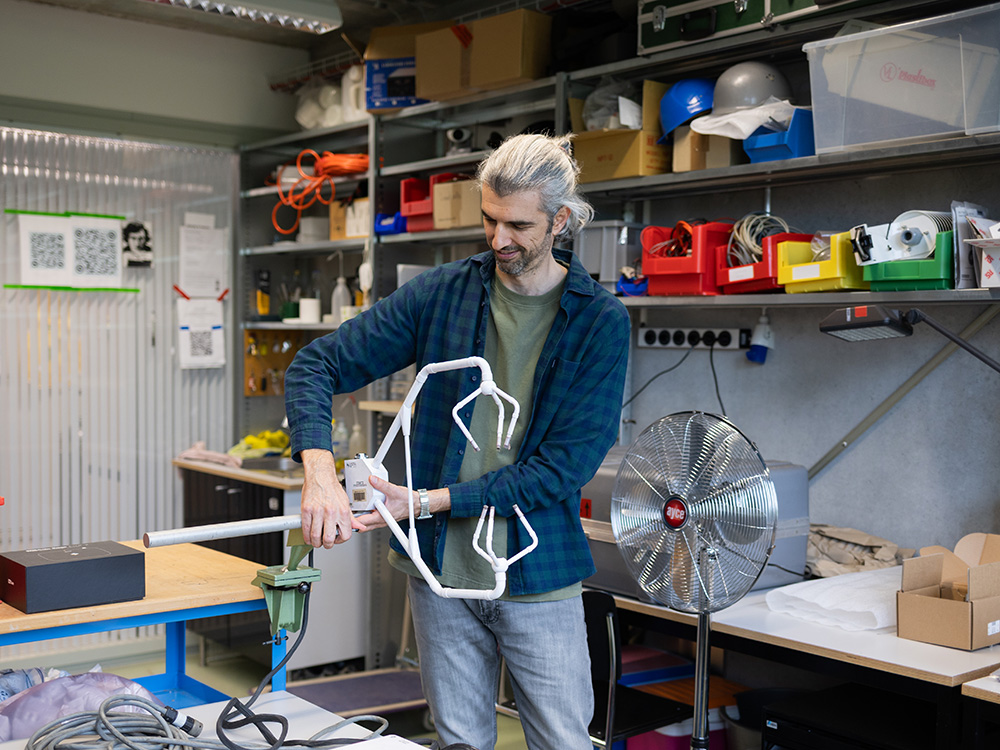
He currently divides his time between several professional roles. After the ICOS project concluded at the end of 2025, he became the lead researcher at the Basel monitoring station. He also holds leadership roles in two other scientific projects. “That involves a lot of management work,” he says. Around 40 percent of his working time remains for his own research, papers and conferences.
He unwinds through the arts: he is learning to play the drums, enjoys films and has discovered another field of interest in Basel. “There are so many interesting art exhibitions here. In Greece, you only have opportunities like that in Athens.”
From measurements to action
Stagakis’ research with real-time CO2 data is relevant for any city seeking to reduce its emissions through action plans. However, tools are still lacking that would make scientific data truly useful for public authorities. “Startups are gradually starting to invest in this translation work,” says Stagakis. “I’m optimistic that the private sector will close these gaps in the coming years.”
Stagakis does not yet know where he will be by then. Eventually, he says, he will be drawn back to Greece and his family.
As for his research, however, he already has his next challenge in mind: distinguishing CO2 from biogenic sources, like human respiration, from CO2 produced by burning fossil fuels. “About 10 percent of the CO2 measured here on the roof could have come from people breathing in the neighborhood,” he says with a chuckle. “Of course, that is not avoidable CO2. For net-zero targets, it would therefore be helpful if we could distinguish fossil fuel CO2 emissions from other sources that have biogenic origin.”
In Focus: the University of Basel summer series
The In Focus series showcases young researchers who play an important role in advancing the university’s international reputation. Over the course of several weeks, we will profile academics from various fields – a small representative sample of the more than 3,000 doctoral students and postdoctoral researchers at the University of Basel.