“The humanities are the very embodiment of free thinking”
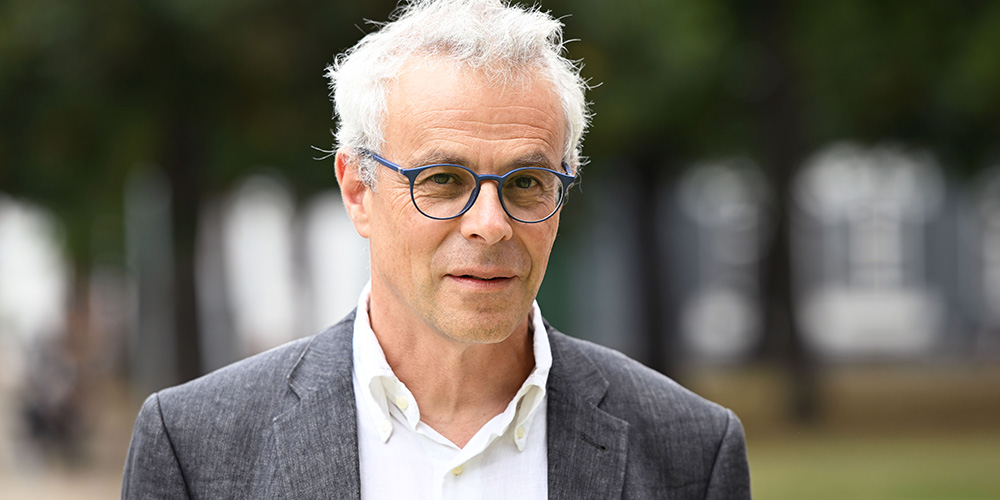
Voices from politics and society regularly question the value of the humanities. Laurent Goetschel, Dean of the Faculty of Humanities and Social Sciences, explains why the humanities are needed precisely in a technologically advanced and turbulent world.
23 June 2026 | Eva Rösch
Mr. Goetschel, you place great importance on research being useful. What do you mean by that?
My own research questions relate to the practice of foreign and peace policy. This makes their findings relevant to political and non-state actors. Whether these actors actually accept and implement them is another matter. Other disciplines in my faculty may, at first glance, seem somewhat more removed from urgent everyday problems. Yet they generate insights that are at least as important, and that serve our society’s self-understanding and help people find orientation. This is particularly significant in the turbulent times we are currently living through.
What do the humanities contribute in the face of current developments?
They question the structures and dangers of trends such as the growing power of tech companies. But that is not all: they also help us understand what defines human beings as thinking, self-responsible individuals. Wherever authoritarian forces seize power, one of the first things they do is abolish the humanities, because the humanities are the very embodiment of free thinking. Even before the latest technological developments, there were repeated attempts to make people compliant through dogma and implicit claims to power. It can therefore do no harm to look to the past in order to understand the present.
What role do the humanities play in a world where machines want to do our thinking for us?
Machines take work off our hands, not thinking. They process what is available in the digital realm very efficiently. The humanities have a wide range of competencies: they help us understand how these new technological possibilities can be used in the various disciplines, and they critically accompany, evaluate, and question such developments. Incidentally, the first large language models (LLMs) were developed by linguists.
Just as the advent of television did not replace human encounters, artificial intelligence will not replace human thought.
What do students at the University of Basel learn that no artificial intelligence in the world will be able to imitate, even ten years from now?
Our students are human beings. They have emotional and self-reflective abilities that no artificial intelligence can imitate. We train our students specifically to use these abilities – not only, but especially, in exchange with artificial intelligence. In the future, they should not simply repeat what has already been said most often and is therefore reproduced by artificial intelligence. They should also be able to make an independent contribution to public debates and current issues.
Basel is a comprehensive university with a strong focus on life sciences. Why does research in Basel need the humanities?
The humanities help investigate the societal and social effects of this technological and medical research, and they can also provide ethical guidance. But humanities scholars also generate new knowledge of their own – for example, about the power of images or the effects of particular narratives. These insights are especially important in today’s digital age and hold considerable potential for innovation.
About the person
Laurent Goetschel is Professor of Political Science at the University of Basel and Director of the Swiss Peace Foundation (swisspeace). Since 2025, he has been Dean of the Faculty of Humanities and Social Sciences.
Where do your subject areas in Basel provide practical support today that goes beyond purely academic theories?
There are research projects on major issues such as climate change and migration. In climate policy, the question arises of what consequences our policies have in other parts of the world – for example, where the lithium for electric car batteries is mined. Compensatory measures can help reduce negative side effects. In migration, it is important to investigate the traumatic experiences refugees were exposed to on their flight routes and how we can respond to these experiences here. In this way, we make a substantial contribution to these people’s well-being and integration, while at the same time reducing the risks and challenges for our society.
Many people associate the Faculty of Humanities and Social Sciences with “musty” libraries and so-called niche subjects with no real use. How do we counter this prejudice?
Whether a field is considered a niche subject can change depending on the situation: A few years ago, there was a debate about abolishing Eastern European Studies in our faculty. Since Russia’s attack on Ukraine, the university has been proud to be able to demonstrate proven expertise, particularly on Russia and Ukraine.
One of the main aims of any degree program must be to enable students to form a well-founded opinion of their own on the basis of existing knowledge.
If you had an unlimited budget and complete freedom to decide: What project would you launch immediately to make thinking in Basel fit for the future?
Basel is emblematic of two of the most important global trends: urbanization and internationalization. The city offers a unique starting point for examining how actors from academia, business, politics, and the arts respond to these challenges and work together in a cross-border context: How can people preserve their inner compass in the interplay of different sectors of society, while putting a stop to both tendencies toward political isolation and tendencies toward conquest? A great deal could be explored and researched here across faculties.