

Having a say, right to the end.
Text: Yvonne VahlensieckCan older people still determine their daily lives and make decisions for themselves when they rely on care? A team of researchers at the University of Basel is trying to find out.
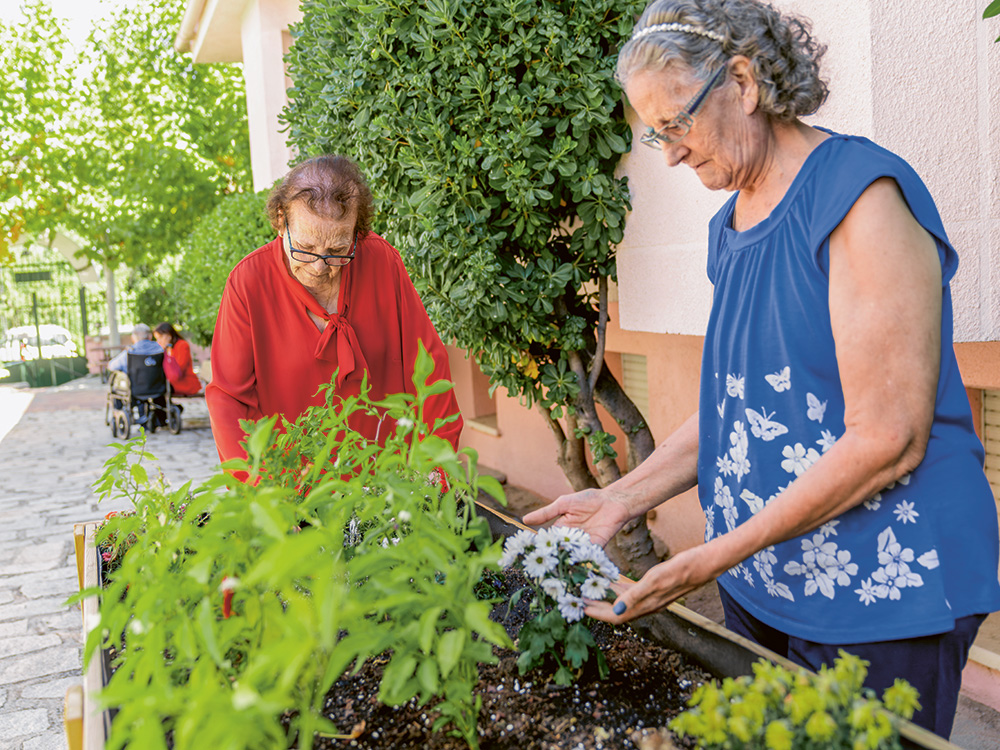
It’s 8 a.m. on the ward of a nursing home in Basel. One by one, the care staff prepare the residents for the day ahead, washing them, dressing them and combing their hair. Once each resident is ready, they’re moved to the large table in the dining area, most of them in wheelchairs. An activation specialist prepares their breakfasts. She knows their preferences, who likes hot chocolate and who prefers coffee. One man takes great pleasure in eating little pieces of bread and jam. He can eat by himself, but the activation specialist has to feed the others, one bite at a time. All the residents here are living with advanced dementia.
Many people are scared of spending their twilight years reliant on others, without any self-determination, living by an institutional timetable. “That’s why most people want to remain in their homes right to the end. They think they’ll have a lot more say there,” says Sandra Staudacher, a social anthropologist and nursing science researcher at the Institute of Nursing Science, University of Basel.
Right now, her team is conducting research in three nursing homes in Basel-Stadt and Baselland to find out what older people need to actively participate and shape their lives and daily routines. The researchers are also exploring how the concept of participation is understood by all those involved. Home care organizations (Spitex) and assisted living are included in the study, as well. The aim is to develop ideas and approaches that will improve participation at all levels: from the bedside through to institutions to cantonal and national authorities.
Research up close
This is why doctoral researcher Séverine Soiron is also at the table this morning, chatting with staff and residents. She knows them all by name. Occasionally, she lends a hand: helping a man with his spoon, asking a woman if she’d like some more to drink. Every so often, she makes notes in a little book. Visits like these are an important part of the EPICENTRE-PARTICIPATIO study. The team is taking an ethnographic approach: Rather than conducting surveys on the topic of participation, for example, Soiron makes observations on-site and talks with everyone involved. Once, she even spent several nights in the nursing home to immerse herself in life at a care home.
“People with advanced dementia are often no longer able to express themselves verbally, which is why they’ve been excluded from research in the past,” says Staudacher. “We explicitly want to include them, however, which is one of the reasons why we chose this approach.” This field research is complemented by formal interviews with nursing home managers and employees, and residents and their relatives, for example. The interviews also go beyond the nursing home environment to include authorities, associations and groups that advocate for older people.
After a final sip of coffee, one of the residents leaves the table and slowly makes his way down the corridor. Every day after breakfast, he pays a visit to colleagues on the neighboring ward. His health still allows him to participate in the community this way. Most other residents are much worse off. They can’t speak or move without assistance. It’s hard to imagine them actively making decisions about their lives with such limited cognitive abilities. The researchers, however, are convinced that people can continue to make decisions right to the end of their lives.
“It begins with daily care and assistance,” says Staudacher. Even if a person can no longer dress themselves, they can still pick out their clothes. A person’s will can be determined through observation and non-verbal communication, too. Health care professionals can acquire the skills to provide interactive care in all areas of a person’s life.
The whole system must get on board
Yet for participation to become established practice, awareness has to change at every level. Care managers, nursing home managers and health departments also have to recognize the needs of older people. The next step is to allow room for developments and make it possible to communicate with residents as equals. “Many health care professionals follow checklists and are scared of doing something wrong.” The management could, for example, let staff know that it’s OK to serve a meal later if that’s what a particular resident wants.
Mit ihrem Projekt rennen die Forschenden vor allem beim Pflegepersonal offene Türen ein. «Viele haben ein grosses Bedürfnis, so zu arbeiten, dass die älteren Menschen mehr partizipieren können. Das bringt auch mehr Zufriedenheit im Job mit sich», so Staudacher. Schon bei den Interviews für die Studie sprudeln die Ideen und einiges wird sogar schon umgesetzt: Eine Institution hat beispielsweise das Vorgehen beim Übertritt vom Spital ins Pflegeheim angepasst.
The researchers are preaching to the choir with this project, particularly among health care professionals. “Many of them long to find a way of giving residents more say. It would make their job more satisfying, as well,” says Staudacher. The health care professionals interviewed for the study are full of ideas, some of which have already been implemented. One institution, for instance, has already changed the way that residents transition from the hospital to the nursing home.
If participation is to be implemented across the board and funding is to be found, society and policymakers need to start thinking differently, too. Staudacher is critical of the fact that the Canton of Basel-Stadt didn’t even mention people in long-term care when it first published its vision of “growing old well and together.” The Swiss Disability Discrimination Act states that people with disabilities should still be able to participate in society. “For example, a blind 80-year-old should have just as much right to be heard and participate in everyday life as a blind person in employment.”
More articles in this issue of UNI NOVA (May 2026).