
Restless Legs Syndrome – Clues from Zebrafish
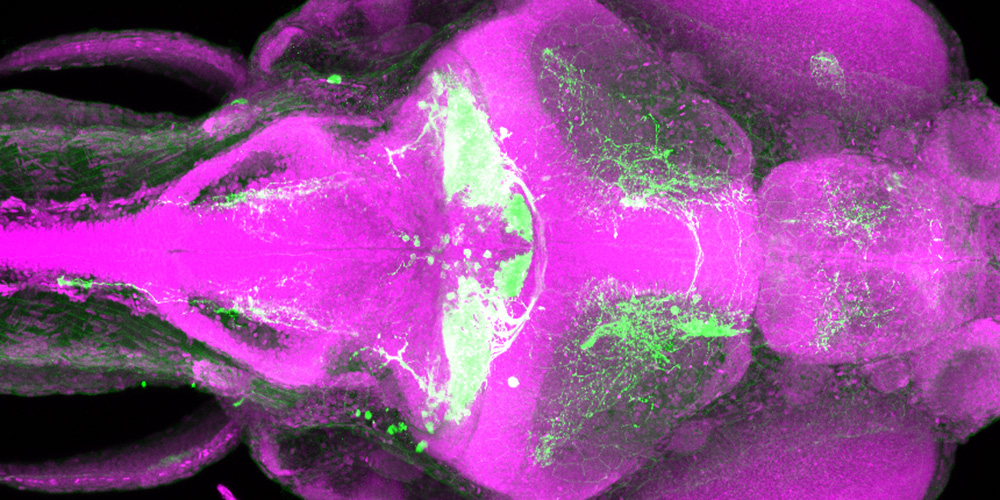
Restless legs, restless nights: Restless Legs Syndrome (RLS) is a common but still mysterious sleep disorder. Using zebrafish, a team at the University of Basel has discovered that a gene associated with RLS is crucial for the development and function of the cerebellum. This may provide clues about the mechanisms that contribute to RLS symptoms.
18 June 2026 | Katrin Bühler
An irresistible urge to move the legs or other areas, often accompanied by unpleasant sensations at night or during rest: Restless Legs Syndrome (RLS) affects millions of people worldwide. Despite being one of the most common sleep-related disorders, its biological causes remain poorly understood.
Researchers led by Professor Alex Schier at the Biozentrum of the University of Basel have discovered new clues about the underlying brain regions and mechanisms. Surprisingly, their findings come from an unlikely model organism: larval zebrafish.
Genes and sleep disorders
“Studies in humans have implicated many different brain regions, but it remains unclear how they relate to RLS,” says Schier. “Our work highlights possible contributions from the cerebellum, a brain region crucial for coordinating movement.”
The project originally started as a broader effort to understand the genetics of human sleep-related disorders, including RLS. “Previous studies identified genes associated with RLS symptoms in humans, but their neuronal and behavioral functions were unclear,” says Dr. William Joo, first author of the study.
Zebrafish with altered movement patterns
The researchers analyzed several genes, but one gene called MEIS1, immediately stood out. When this gene was mutated, the movement patterns of zebrafish larvae changed significantly.
Zebrafish larvae typically move in a “burst and glide” pattern – swimming, pausing, and swimming again. “In MEIS1 mutant zebrafish, bouts of movement became much longer,” says Joo. “This prompted us to search for differences in brain activity or structure in the mutants.” Indeed, the researchers observed developmental abnormalities in the cerebellum of MEIS1 mutant zebrafish.
The cerebellum in focus
Particularly affected were the so-called Purkinje cells, prominent cerebellar neurons that suppress the activity of other neurons and help coordinate movement. “This cell type is partially lost in the cerebellum of zebrafish mutants,” says Joo. “Our results indicate that the activity of downstream neurons becomes perturbed when the Purkinje cells are missing, and that this is what generates abnormal locomotion patterns in the mutant larvae.”
Furthermore, the researchers tested drugs commonly prescribed to treat RLS and found that these medications could normalize the behavior of mutant fish.
Clues for future therapies
This study is one of the first to mechanistically demonstrate how a gene linked to RLS affects both brain development and movement patterns and raises the possibility that other RLS risk genes may play similar roles. “Zebrafish have provided great insights into the functions of this RLS-related gene,” adds Schier. “But future studies must further investigate whether the same brain region and mechanisms are also relevant in RLS patients.”
These efforts may eventually support the development of more effective treatments and improve the diagnosis of RLS, which so far is based almost entirely on patient symptoms.
Original publication
William Joo, Joo Won Choi, and Alexander F. Schier.
Disinhibition of cerebellar output by loss of Restless Legs Syndrome-associated gene MEIS1.
Current Biology (2026), doi: 10.1016/j.cub.2026.05.043