
In Focus: Florian Knappe investigates how sport can support refugees
A week in a Greek refugee camp changed the course of Florian Knappe’s career. Today, he investigates how sports programs in asylum centers can support refugees.
16 July 2026 | Angelika Jacobs
“My mother would have liked me to work in finance,” says Florian Knappe with a laugh. Some 20 years later, on a warm June afternoon, he remembers how she sent him to a bank for three days of work experience while he was still in school. Instead, he decided to study sport at the University of Basel.
In a meeting room at the Department of Sport, Exercise and Health (DSBG), Knappe talks about the experiences that shaped his life. “Forced migration is part of my family history. My grandfather fled from Silesia to Dresden as a child, and my father tried several times to leave the GDR.” Eventually, his father managed to escape to Switzerland via Hungary.
The experiences of his father and grandfather probably helped shape the path Florian Knappe would later take. “It began during what was known as the refugee crisis from 2015 onward, when I was still a student,” he recalls. “The photo of a drowned boy on a Mediterranean beach went around the world.” Even ten years later, it is clear how deeply this image affected him.
Knappe first spent a week volunteering at one of the informal refugee camps in northern Greece that had formed after the border with what is now North Macedonia was closed. Among other things, he helped distribute tents, blankets and hygiene products.
Violence at the border fence
During this time, he also witnessed pushbacks, the brutal practice of forcing refugees back at the border fences. “Some were beaten unconscious, and we knew the ambulance wouldn’t come.” Although it was forbidden to transport refugees by car, the volunteers had no other choice: “The injured had to get to the hospital somehow.”
Throughout his studies, Knappe repeatedly returned to refugee camps as a volunteer. “I also met my partner during one of these stays,” he says with a smile. She still works for an aid organization today.
Over time, the focus of his work shifted. Refugees were moved into official camps, where their days were marked by monotonous waiting. “That’s when the psychological strain became more apparent,” says Knappe. “There was a lack of opportunities to break out of negative thought patterns.”
Can sport help?
As a sport science student, he began to wonder how sport might help in this context. This became the idea for his master’s thesis: He carried out a sports project in refugee camps in Greece and evaluated whether regular participation had an effect on the mental health of refugees.
After completing his master’s thesis, he worked as a physical education teacher, but the issue stayed with him. Alongside his teaching job, he continued his work as part of a doctoral dissertation, investigating the biopsychosocial effects of sports programs for refugees and what participation meant for those taking part.
As his research became more intensive, he had to choose between research and teaching. It was not an easy decision, especially since he had since become a father himself. During the most intensive phase of his doctorate, he had to spend an extended period in Greece shortly after the birth of his second child, which was a strain on the whole family. Without the support of his partner and his supervisor, he says, he would not have managed to continue on this path.
Research through personal conversations
“I was always aware that I am a white, privileged man,” Knappe says self-critically of his research. “That’s why I didn’t want to go into these camps with ready-made solutions. I wanted to listen to the people there and develop something together with them.”
The practical insights from his doctoral dissertation came not only from quantitative analysis, but also from conversations with participants. He learned that the activities helped them dwell less on negative thoughts and made it easier for them to start conversations with others.
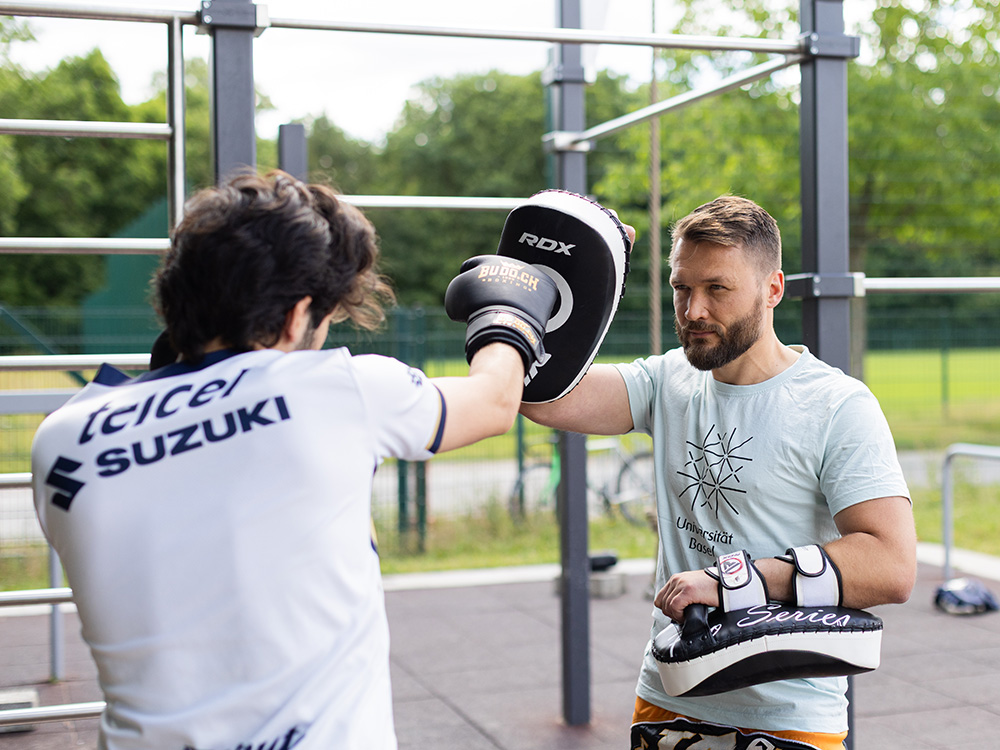
“Sport can create a setting for interaction, positive moments and distraction,” says Knappe. But such programs are not automatically beneficial: competition and social exclusion in competitive activities can also make the situation worse. “That’s why it is important to train the coaches accordingly.”
Coach the coaches
This is precisely what Knappe is working on today as a postdoc in a project funded by the Eucor university consortium. The project also raises the question of how such programs can continue once research projects end and no more research funding is available.
Under the title “Coach the coaches,” he is working with federal asylum centers in Basel and Zurich to establish sports programs as an integrated part of the centers’ work. Staff at the asylum centers are being trained so that they can offer regular sports activities. The focus is on activities for unaccompanied minors and women, because these groups are often exposed to particularly high levels of psychological stress while fleeing their home countries.
“I want to do my small part to improve the situation of these people,” says Knappe, explaining his motivation. Instead of working in a bank or as a physical education teacher, he is now a researcher who listens and wants his work to make a difference for the people it is meant to support.
In Focus: the University of Basel summer series
The In Focus series showcases young researchers who play an important role in advancing the university’s international reputation. Over the course of several weeks, we will profile academics from various fields – a small representative sample of the more than 3,000 doctoral students and postdoctoral researchers at the University of Basel.