

Sharing experience, shaping the future.
Text: Evelyn Weissheim
In January this year, Roland P. Bühlmann handed over to his successor, Conrad Eric Müller, as President of AlumniBasel after 17 years in the role. Like Bühlmann before him, Müller aims to create a thriving network in which all participants can share their experience, take on responsibilities and consider the future together.
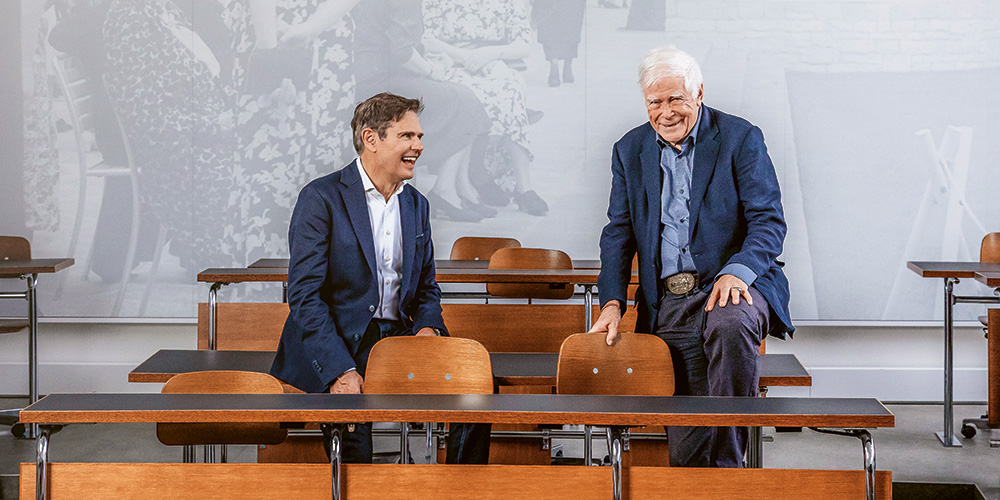
Speaking to Roland Bühlmann, it quickly becomes clear that he likes to make people laugh and to laugh about himself in equal measure. When he reflects on his career, much of it seems almost a natural progression.
Bühlmann belongs to a generation for which going to university was more like entering a world of possibilities than simply a career move. He studied chemistry and biochemistry at the University of Basel and wrote his dissertation in 1973 at what was then the Institute of Physiological Chemistry of the Faculty of Medicine. “As the last chemist,” he smiles — for this period saw the founding of the Biozentrum and the restructuring of the Faculty of Science.
Back then, young researchers in the laboratories were working on topics that would go on to shape entire fields of research. At the same time, large Basel-based companies were on the hunt for new talent. “Instead of us looking for positions, staff from Sandoz, Ciba-Geigy and Roche came looking for us,” recalls Bühlmann.
He consciously decided not to go with one of the big companies and instead forged his own path, achieving huge success with the development of a novel blood test for vitamin D3 levels. Indeed, he enjoyed the process so much that he immediately went on to develop further diagnostic procedures and set up his own company by the name of Bühlmann Laboratories.
For Bühlmann, success is not the aim but rather a natural consequence of curiosity and perseverance. This attitude is a common theme that can also be seen in his commitment to AlumniBasel. He has never seen the association as a place for nostalgia but rather as a space for connection between faculties, generations, the university and society. One example is the Alumni Prize, which he endows and whose funding he will now ensure for the next 50 years.
Rather than a bequest, Bühlmann prefers to see this as a tool for highlighting the achievements of alumni and for paying tribute to their work. “If you want to promote something, you also have to fund it.” Despite its matter-of-fact phrasing, this sentence perfectly describes how Bühlmann understands responsibility.
Choosing a path in life
Bühlmann is now giving up his role after 17 years as president. The fact that he stayed longer than planned is something that “just happened, as I was having so much fun.” Accordingly, it’s all the more important to him that his role be taken over by someone who, as well as enjoying it, will also bring fresh perspectives and have the courage to think differently.
Conrad Eric Müller fits this description perfectly. He has been president of AlumniBasel since January 2026, and there is much that feels familiar. His studies at Basel University were formative for him in many respects: “The university did more than just prepare me for my professional career,” he says. Indeed, it was here that, in addition to studying medicine, he met his wife and discovered the close connection between freedom and responsibility.
Time and again, Müller’s professional career has brought him to situations that revolve around the next generation. As a pediatrician and pediatric surgeon, he is always dealing with questions of life, vulnerability and the future, both in managerial positions and on a voluntary basis. He is committed to helping children across national borders, often in places where health, education and safety are not guaranteed.
With regard to AlumniBasel, Müller talks more about possibilities than structures — about proximity, accessibility and breaking down barriers. He doesn’t see digital formats as a substitute for real encounters, but rather as an invitation to exchange ideas in an accessible manner. The question of young graduates and students is particularly close to his heart.
More than just academic knowledge
“What characterizes us as alumni is that, as well as academic knowledge, we’ve gained experience that we want to pass on. This accumulated experience is the actual capital of AlumniBasel,” says Müller. With that in mind, he sees the mentoring programs, the encounters between different generations of alumni, and specific support schemes such as the scholarship funds as key tasks of the association. Knowledge brings freedom of thought and action, he says. “And this freedom must remain accessible to all.”
Rather than having similar career paths, Bühlmann and Müller are linked by their similar views of the university, which they both see as a place where people learn to assume responsibility for themselves and for society.
Accordingly, the change of leadership at AlumniBasel doesn’t feel like a break but rather a continuation. Bühlmann is handing over the reins with confidence, and Müller is taking them up with renewed energy.
More articles in this issue of UNI NOVA (May 2026).