

A playground for the mind.
Text: Angelika JacobsUsing spontaneous discussions, a ping-pong game of creative ideas and intensive calculations, Admir Greljo explores the smallest building blocks of matter and some of the biggest unanswered questions in the universe.
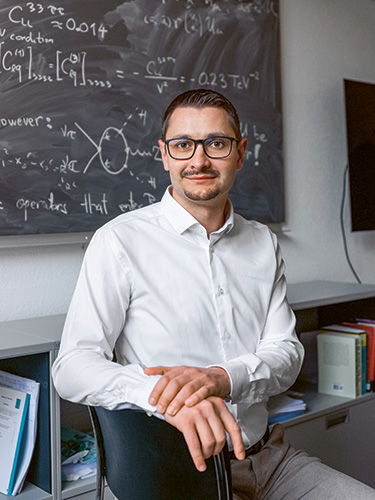
For Greljo, it was a dedicated teacher and a book that provided the initial spark for a career that deals with the great mysteries of the cosmos. It sounds like every teacher’s dream. It was a book of physics problems, he recalls. He was given it by his teacher in Mostar, Bosnia and Herzegovina, when he was twelve. “I was fascinated by the mathematical precision along with the possibility of describing and predicting real phenomena using formulas.” Soon he began competing in physics olympiads, later studying physics in Sarajevo and completing a doctorate in Ljubljana in 2014, aged just 24.
Today, 37-year-old Greljo is in his office at the Department of Physics. He talks about his career, his morning routine with his two children and his daily work as a professor. What awaits him at work after he’s taken his son to school? “Not many fixed appointments, but lots of spontaneous discussions with my team,” he says. He describes his work as a ping-pong game of creative ideas on the board, followed by phases of intensive calculations. His work ranges from the smallest building blocks of matter to the vast scale of the cosmos. Two extremes on the spectrum. How does that fit together?
A puzzle with flavor.
“There are unanswered questions about elementary particles that could also provide answers to fundamental cosmic questions,” explains Greljo. One example is the “flavor puzzle”: Elementary particles, such as the electrons and quarks in atoms, have heavier relatives. Based on their properties, they are grouped into three categories, known as “flavors” or “generations.”
Matter consists of first-generation elementary particles. Particle accelerators such as those at CERN can also produce heavier elementary particles, but these decay quickly. “Why do these additional generations exist in the first place? Why are there exactly three? And why do they differ so greatly in mass? It’s a mystery!” says Greljo, his eyes bright. His team is developing new models around these questions to predict what results the experiments at CERN should deliver. In this way, the researchers are attempting to uncover unknown symmetries and patterns in the universe, expanding our understanding of matter and the cosmos.
Greljo’s interest in the flavor puzzle stems from his time as a postdoc in Gino Isidori’s team at the University of Zurich, his first stop after completing his doctorate. “This collaboration shaped the way I view physical problems and the questions I grapple with,” says the young professor. Isidori, who was also new to Zurich at the time, remembers his former postdoc: “He’s one of the most brilliant young scientists I’ve had the privilege of working with in my career.” He was particularly impressed by Greljo’s enthusiasm for fundamental problems in physics. “He stands out in particular for his unique creativity in challenging current knowledge and seeking new ways to test our hypotheses through experiments.”
“Out of the box.”
Even today, as Greljo himself supervises postdocs and doctoral students, his enjoyment of discussions and thought experiments is evident. Thinking “out of the box” is important to him. This leads to brilliant ideas for new models and calculations.
The experiments are conducted by other research groups, but Greljo explains that they all collaborate closely. For example, his group has already provided theoretical foundations and tools for two major CERN projects: the CMS and Atlas experiments. On the other hand, the CERN experiments sometimes yield unexpected results that are then incorporated into new hypotheses in Basel.
Greljo spent influential years at CERN as a senior research fellow. “A truly unique place,” he enthuses. The international environment and close interaction with experimental researchers were very inspiring. The field benefits immensely from global interconnections between theoretical and experimental particle physics. An individual research group would hardly come close to answering fundamental questions, even with decades of work. It takes an entire community of researchers working intensively together, emphasizes Greljo.
Yet it’s not always experienced researchers in large collaborations who steer their own thinking in new directions. “Sometimes students come to me with questions that open up completely different perspectives for me,” he says. Starting in the fall semester of 2026, he’ll have even more contact with students through his lectures in quantum mechanics, something that clearly delights him.
When asked what, apart from his family, provides balance to his research and teaching, Greljo smiles. For him, studying particle physics never feels like a burden. Rather, it offers a wonderful playground for the mind. His attitude perhaps has roots in his early childhood, even before the dedicated teacher and the book of physics problems. Books became a playground for him at a time when real playgrounds were out of reach, Greljo recalls. When he was three years old, the war broke out in Bosnia and his family often had to seek shelter from the bombs in a basement. To distract him, his parents taught him to read and do arithmetic. Maybe that’s when his love of mathematical precision and formulas began — bringing order to a chaotic world.
Admir Greljo has been Professor of Theoretical Particle Physics and Cosmology at the University of Basel since 2023. After completing his doctorate in Ljubljana, he had research stays in Zurich, in Mainz, at CERN and in Bern. His work focuses on the fundamental laws of nature at the smallest scales and on open questions in particle physics. He lives with his wife and two children in Basel.
More articles in this issue of UNI NOVA (May 2026).