Light changes a magnet’s polarity
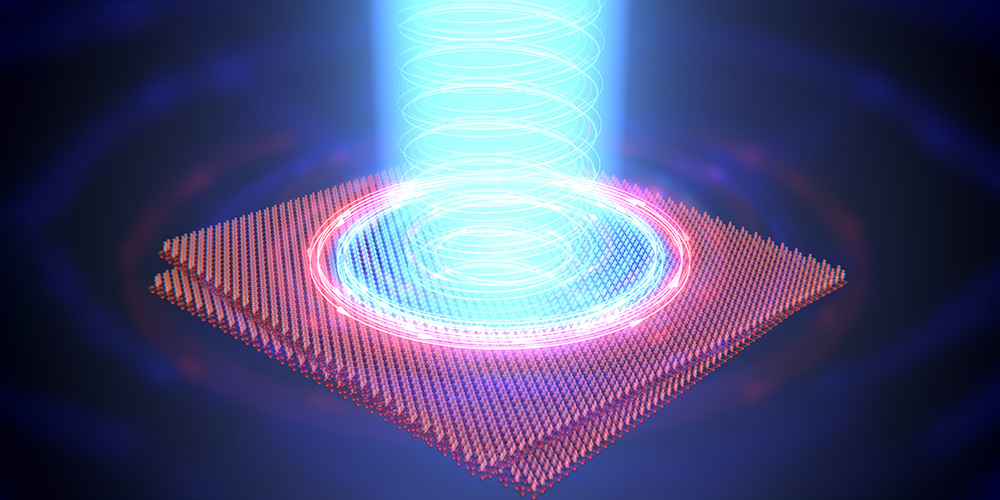
Researchers at the University of Basel and the ETH in Zurich have succeeded in changing the polarity of a special ferromagnet using a laser beam. In the future, this method could be used to create adaptable electronic circuits with light.
28 January 2026 | Oliver Morsch
In a ferromagnet, combined forces are at work. In order for a compass needle to point north or a fridge magnet to stick to the fridge door, countless electron spins inside them, each of which only creates a tiny magnetic field, all need to line up in the same direction. This happens through interactions between the spins, which have to be stronger than the disordered thermal motion inside the ferromagnet. If the temperature of the material is below a critical value, it becomes ferromagnetic.
Conversely, to change the polarity of a ferromagnet, one usually needs to first heat it up above its critical temperature. The electron spins can then reorient themselves, and after cooling down, the magnetic field of the ferromagnet eventually points in a different direction.
A team of researchers led by Prof. Dr. Tomasz Smoleński at the University of Basel and Prof. Dr. Ataç Imamoğlu at the ETH in Zurich have now managed to bring about such a re-orientation using only light – without any heating. They recently published their results in the scientific journal Nature.
Interactions and topology
“What’s exciting about our work is that we combine the three big topics in modern condensed matter physics in a single experiment: strong interactions between the electrons, topology and dynamical control,” Imamoğlu says. To achieve this, the researchers used a special material consisting of two wafer-thin layers of the organic semiconductor molybdenum ditelluride, which are slightly twisted with respect to each other.
In such materials, so-called topological states can form. Simply speaking, topological states can be characterized based on what they look like: a ball (no hole) or a doughnut (one hole). Importantly, a ball cannot be turned into a doughnut by a simple deformation, which means that topological states are unequivocally and permanently defined.
In the new experiments co-supervised by Smoleński and Imamoğlu, the electrons could be tuned between such topological states that are insulating and metallic states that are conducting. Remarkably, interactions cause the electron spins in both states to align parallel to each other, turning the material into a ferromagnet.
Dynamical control of the ferromagnet
“Our main result is that we can use a laser pulse to change the collective orientation of the spins,” says Olivier Huber, a PhD student at ETH, who carried out the experiments together with his colleague Kilian Kuhlbrodt and Tomasz Smoleński. A few years ago, this had already been done for single electrons, but now the “switching” or change of polarity of the entire ferromagnet was achieved. “This switching was permanent and, moreover, the topology influences the switching dynamics,” says Smoleński.
In this way, the laser pulse can also be used to draw new boundary lines, inside of which the topological ferromagnetic state is located. This can be done repeatedly, so that a dynamical control of the topological and ferromagnetic properties is possible. To show that the tiny ferromagnet, which is only a few micrometers in size, had actually changed its polarity, the researchers measured the reflection of a second, much weaker laser beam. This reflection revealed the orientation of the electron spins.
“In the future, we will be able to use our method to optically write arbitrary and adaptable topological circuits on a chip,” says Smoleński. This approach could then be used to create tiny interferometers, with which extremely small electromagnetic fields can be measured.
Original publication
Olivier Huber, Kilian Kuhlbdrodt et al.
Optical control over topological Chern number in moiré materials
Nature (2026), doi: 10.1038/s41586-025-09851-w