Christoph Gerber — a life devoted to the nanosciences

Forty years ago, Gerd Binnig, Carl Quate and Christoph Gerber published their invention of the atomic force microscope. Even at the age of 83, Gerber continues to share his enthusiasm for this special microscope, which was instrumental in allowing scientists to explore the nanoworld.
03 March 2026 | Christine Möller
Almost every Tuesday, Professor Dr. Dr. h.c. Christoph Gerber can be found at the Department of Physics of the University of Basel. To this day, he is still fascinated by research into atomic force microscopy and cantilevers, as well as their applications. As a child, however, he would never have dreamt that he would one day become an award-winning physicist.
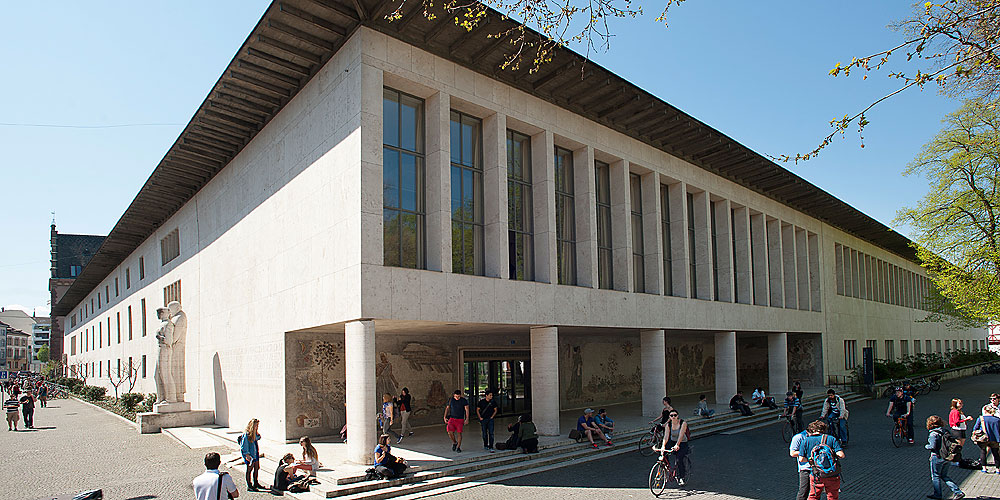
Born in Basel in 1942, Gerber had an affinity for the University of Basel from an early age, as he used to play on the lawns in front of the main building on Petersplatz. At that time, he was also discovering his passion for books and spent many nights reading in secret. He was particularly impressed by biographies of natural scientists. “Characters like Michael Faraday, who — as a bookbinder — would not only bind but also read the findings of great scientists and replicate them experimentally, made a huge impression on me,” he recalls.
Initially, however, Gerber didn’t plan on becoming a scientist himself. He completed an apprenticeship as a precision engineer and began his career at the Swiss company Contraves, which developed instruments and measurement systems.
Success as part of a team
In 1966, he took on a role at the IBM Research Center in Rüschlikon — a decision that would have a lasting influence on his career. There, he worked closely with the future Nobel laureate Dr. Heinrich Rohrer. After the young physicist Dr. Gerd Binnig joined the team, Gerber focused on tinkering with technical issues that hampered development of the scanning tunneling microscope (STM).

The breakthrough came in 1981. Specifically, the team of scientists — comprising Rohrer, Binnig and Gerber as well as Edmund Weibel, a research assistant who subsequently joined the team — proved that a tunnel current flows between the nanoscale tip of the microscope and a conductive sample, and that this current can be used to generate an atomic image of the surface.
At first, there were mixed reactions from the world of science. “Whereas the doors opened for further research funding at IBM, the renowned journal Physical Review Letters rejected an initial publication — arguing that although the microscope was a technical marvel, it did not represent a scientific innovation. The researchers were not discouraged, however, and pushed ahead with the development of the scanning tunneling microscope. Binnig and Rohrer received the Nobel Prize for this work in 1986.
A highly cited publication
The same year, together with Binnig and Quate, Gerber published another groundbreaking paper — this time on the invention of the atomic force microscope.
“We were irritated that the STM could only be used to analyze conductive surface structures,” says Gerber. “With that in mind, we worked day and night on the idea of measuring not the tunnel current but rather the forces that act on the tiny microscope tip while scanning a sample.”
This approach, which now dates back 40 years, proved to be a huge success. The publication in Physical Review Letters in 1986 is now one of the journal’s most-cited articles and has opened up new avenues in physics, chemistry, biology and medicine.
Looking back, Gerber says: “In the field of nanotechnology, which was still in its infancy in those days, the invention of atomic force microscopy led to a paradigm shift in the understanding and perception of matter at its most fundamental level. The AFM can depict, analyze and manipulate materials in unprecedented resolution and can be combined with a whole host of other technologies. This makes it one of the most powerful and versatile tools in nanoscience, continuing to inspire researchers all over the world.”
Development continues
The publication was followed by a number of years with an international focus. Gerber worked at the IBM Research Laboratory, at Stanford University, and at LMU Munich, among others, trained numerous colleagues on using the new microscopes, supervised early career researchers and gave talks around the world.
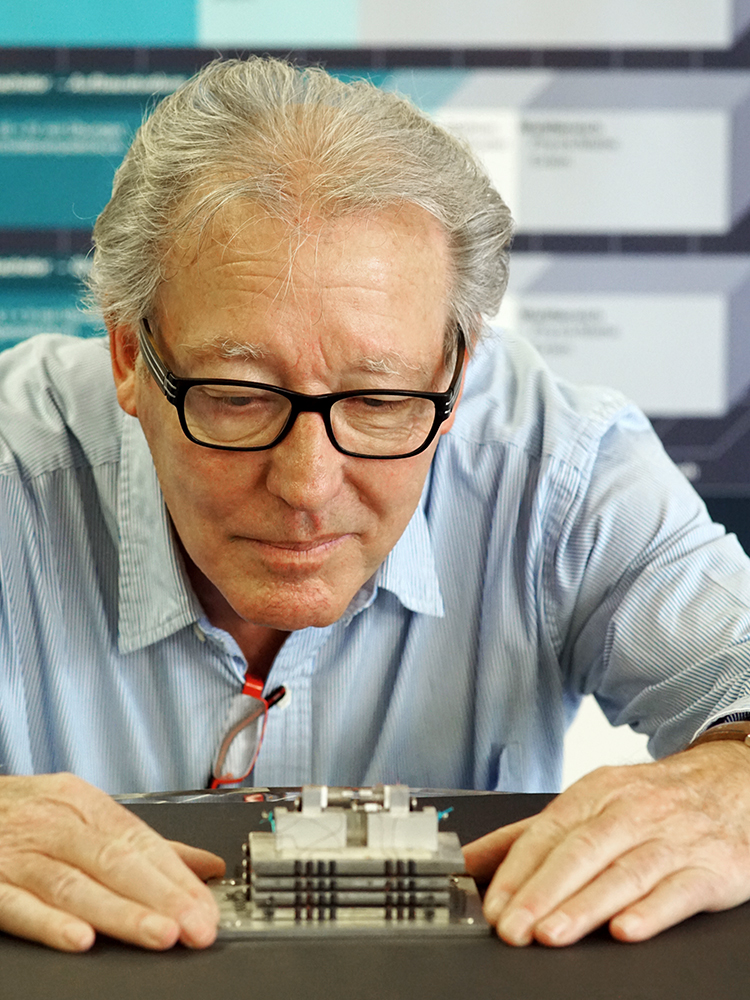
Gerber soon recognized that the cantilevers used in the atomic force microscope also had huge potential. “If you fit molecules to them, it’s possible to measure when compounds from a test solution bind to the molecules,” he explains. “We therefore have a tiny diagnostic tool at our disposal that can quickly and cheaply measure very small quantities of different substances.” The applications range from detecting specific molecules and microorganisms to highly sensitive sensors for magnetic or electric fields.
In the late 1990s, a new era began for Gerber. He retired from IBM and became project leader and director of scientific communication at the newly founded National Center of Competence in Research (NCCR) Nanoscale Science. In 2006, this NCCR evolved into the Swiss Nanoscience Institute SNI, in which Gerber then also worked for many years — and of which he has been an honorary member since 2017.
Teamwork and perseverance
Thanks to his pioneering work, Gerber has become a highly esteemed scientist — as demonstrated by his honorary doctorates, honorary professorships and distinctions such as the Kavli Prize, the Lifetime Achievement Award from the journal Nature, the Albert Einstein World Award of Science, and his appointment as a Citation Laureate by Clarivate.
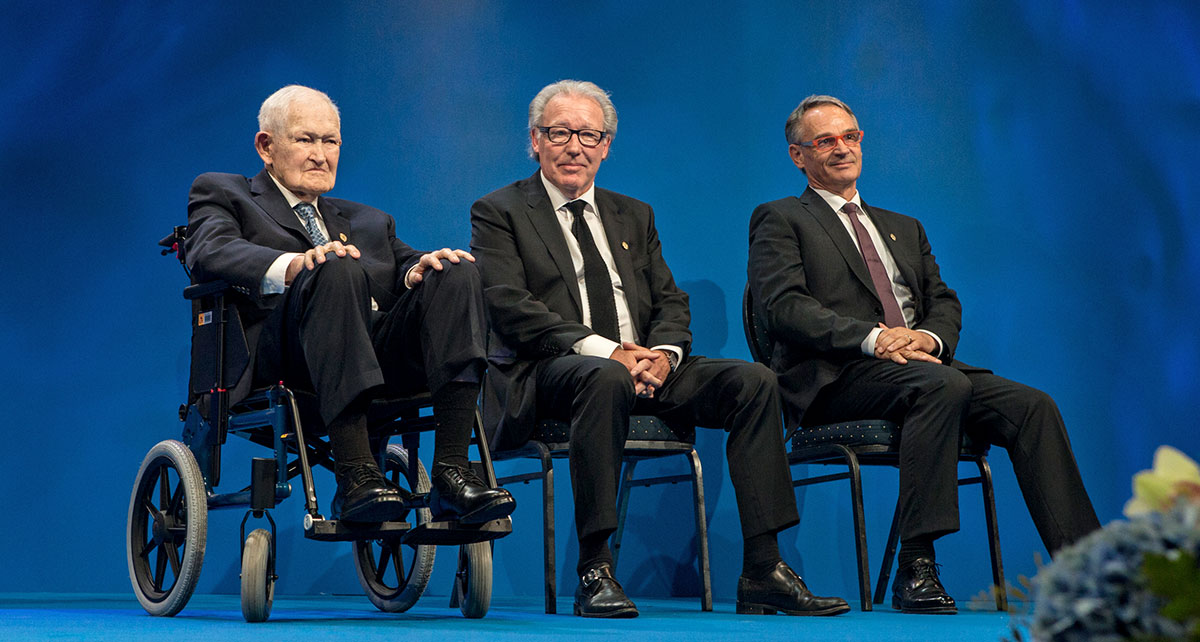
Christoph Gerber emphasizes that science is a collaborative endeavor: “It is the culmination of more than 50 years of passion, commitment and perseverance, and the unabated urge of curiosity.” When asked about his career credo he says: “It’s also very important to question and challenge dogmas, to go your own way and to work hard on achieving your vision. The teams of mentors, colleagues and supporters have also played a crucial role in my journey.”