Graphene reveals surprising types of superconducting states
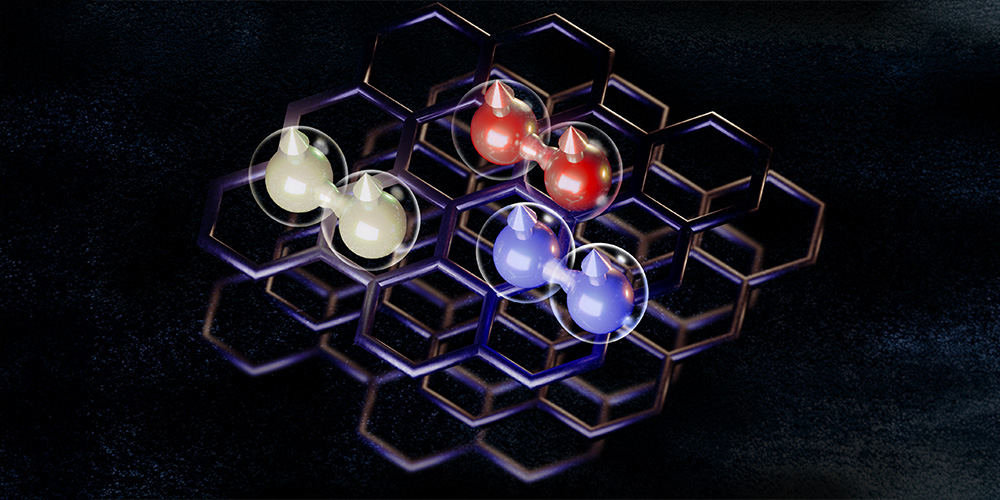
The ultra-thin material graphene can surprisingly host several superconducting states. This has been demonstrated by researchers at the University of Basel together with colleagues from the Massachusetts Institute of Technology. Some of these states are even stabilized by magnetic fields, rather than being destroyed by them, as is usually the case.
29 June 2026
Graphene is considered one of the simplest yet most fascinating materials in physics: it consists of a single layer of carbon atoms. When several such layers are stacked in a specific natural arrangement, the resulting material can have extraordinary electronic properties.
An international research team involving the University of Basel has now observed several forms of superconductivity in a specific form of graphene known as rhombohedral graphene. In a superconducting state, electric current flows through a material without resistance. Normally, this state occurs only at very low temperatures, and magnetic fields can quickly destroy it.
More stable in magnetic fields
This was precisely the surprising finding in the experiments: The newly observed superconducting states persisted even in comparatively strong magnetic fields. In certain cases, the superconductivity became even more stable when exposed to a magnetic field.
This contradicts the behavior of classical superconductors, in which magnetic fields break up the electron pairs responsible for the resistance-free flow of current.
The samples studied consisted of four or five atomically thin layers of graphene. These layers are not artificially twisted, as in other graphene experiments, but follow a natural stacking arrangement in a high-purity crystal. The researchers were able to tune the electronic properties in a targeted way by controlling the number of electrons and the electric field in the material by applying electrical voltages.
Challenging measurement conditions
The group led by Prof. Dr. Dominik Zumbühl at the Department of Physics at the University of Basel played a key role in this work. The Basel team helped make it possible to carry out the measurements under particularly challenging conditions: at extremely low temperatures, with very weak electrical signals, and under controlled magnetic fields in different directions. Such measurements are crucial for making these delicate superconducting states visible in the first place and for distinguishing them from one another.
In the process, the researchers encountered superconducting states that cannot be easily explained by existing models. “These highly unusual superconductors so far are eluding a theoretical understanding, making them particularly intriguing and exciting to investigate,” says Armel Cotten, one of the study’s lead authors and a doctoral student in Dominik Zumbühl’s group.
This was particularly evident in the magnetic-field measurements. “These superconductors in rhombohedral graphene are really stunning: they survive the largest magnetic fields we could apply in the lab, and can even get stronger in some cases,” adds Dominik Zumbühl.
Entire family of unusual superconducting states
It is still unclear what microscopic mechanisms underlie this phenomenon. One possible explanation is that the electrons in these states pair differently than in classical superconductors — for example, with their spins aligned in the same direction. This could make them less sensitive to magnetic fields.
The study thus demonstrates that even a seemingly simple material like carbon can give rise to an entire family of unusual superconducting states. The discovery provides a new model system for better understanding unconventional superconductivity. Researchers are interested in such materials, among other reasons, because in the long term they could open up new avenues for lossless electricity transmission, novel electronic components, or topological quantum states.
This text is based on an MIT press release.
Original publication
Junseok Seo, Armel Cotten, Shenyong Ye, et al.
Family of magnetic field-boosted superconductors in rhombohedral graphene
Nature (2026), doi: 10.1038/s41586-026-10815-x