Physicist establishes new methods for use in forensic medicine
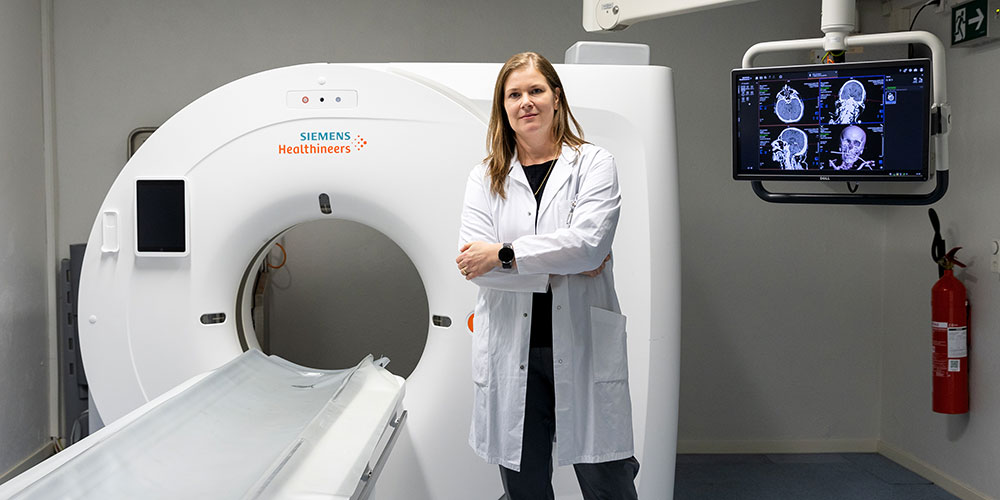
Claudia Lenz has developed a method that increases the amount of time available to provide proof of strangulation injuries, thereby improving the evidence base for violent crimes. The physicist was awarded the Emilie Louise Frey Prize at this year’s Dies academicus for this and other work as part of her habilitation.
02 December 2025 | Catherine Weyer
Just a few days – that is how long signs of strangulation are usually visible from the outside. After that, visible traces such as strangulation marks fade, removing the evidence of violent crime. Victims of violence are therefore examined for signs of strangulation only up to a few days after the crime. This is currently the standard practice in forensic medicine, but it is about to change.
Thanks to Dr Claudia Lenz. The research group leader at the University of Basel’s Institute of Forensic Medicine has set new standards with her study: she was able to show that internal injuries can be detected using magnetic resonance imaging (MRI) for much longer than previously thought – namely up to 12 days. This represents a significant extension of the window of time in which objective evidence of a violent crime can be secured.
Bridging the gap between physics and medicine
For her study, Lenz examined 20 strangulation survivors using special MRI sequences. She was able to document bleeding and swelling in the muscles, thyroid and lymph nodes that would otherwise have remained hidden. She was awarded the Emilie Louise Frey Prize at the Dies academicus for this and other research as part of her habilitation.
“Claudia Lenz’s work is characterized by the fact that it bridges the gap between technical sciences and medical applications,” says Professor Eva Scheurer, Dean of the Faculty of Medicine, who awarded this year’s Emilie Louise Frey Prize. She notes that, through a great deal of networking and continuous effort, Lenz has succeeded in establishing and driving collaboration between the different fields.
Final piece of the puzzle
“I never thought my habilitation would be distinguished in this way,” says Claudia Lenz. The physicist, who holds a doctorate, is all the more delighted with the appreciation her work has received along with the prize. However, the social relevance of her research is even more important to her: modern imaging, such as MRI and computed tomography (CT), can significantly support forensic services and thus make an important contribution to legal certainty.
“This work was the final piece of the puzzle needed to embed our research in the forensic examination of victims of violence,” she explains. Specifically, this means that when the Institute of Forensic Medicine moves to its new location on Socinstrasse in 2027, MRI examinations will be carried out as standard following suspected violence to the neck.
Focusing on women in natural sciences
The Emilie Louise Frey Prize is awarded for outstanding research by young female scientists and is intended to encourage them in their academic careers. Lenz’s career has been based at the University of Basel. “I’ve consistently had opportunities here to work in interesting places.” Born in Solothurn, she studied physics in Basel before obtaining her doctorate in biophysics at the University Hospital Basel and joining the Institute of Forensic Medicine in 2017.
She is also delighted about the prize because it gives her research visibility. “It’s important to me to show girls and young women that they can also excel in natural sciences.” She describes herself primarily as curious: “I wanted to understand connections and found the specific applications in medicine particularly exciting. After all, modern medicine is inconceivable without technological advances.”
Next project: making hematomas visible on dark skin
Claudia Lenz says her research is somewhat niche, but it has a major advantage: “It has direct applications in society.” Even though, in relation to forensic medicine, many people think primarily of the deceased, more than half of the people who are examined in forensic medicine are still alive.
Her current research project also has a direct social benefit, and is already being used in forensic medicine: infrared photography. “On dark skin in particular, hematomas are difficult to detect with the naked eye,” explains Lenz. Under infrared light, however, the bruising becomes visible and thus also provable. Another piece of the puzzle to strengthen legal certainty.