Exercise improves social skills in schoolchildren
Short exercise sessions can help children build social relationships. This has been demonstrated by researchers from the Department of Sport, Exercise and Health at the University of Basel. An “active” short break could be a fun way to integrate these findings into everyday school life.
13 January 2026 | Lara Uebelhart
Exercise is good for many things – including making it easier to establish social relationships. Studies show that there is a link between physical activity and what are known as social-cognitive skills. These are the skills necessary for social interactions, such as recognizing other people’s emotions or empathizing with them.
Melanie Berger is a doctoral student in the Department of Sport, Exercise and Health (DSBG) and conducts research on the intersection between exercise and cognitive skills, with a focus on children and young people. There is a connection between sport and social cognition, and researchers at the DSBG are interested in its potential. “We already know that people who score well in social cognition do more exercise. However, it is unclear whether sport specifically promotes this ability,” says Berger, adding that so far, there has been hardly any research into this.
In their study, recently published in the journal Medicine & Science in Sports & Exercise, the researchers focused on the ability to recognize emotions and conducted practical research in a school context.
Exercising alone promotes emotion recognition in the short term
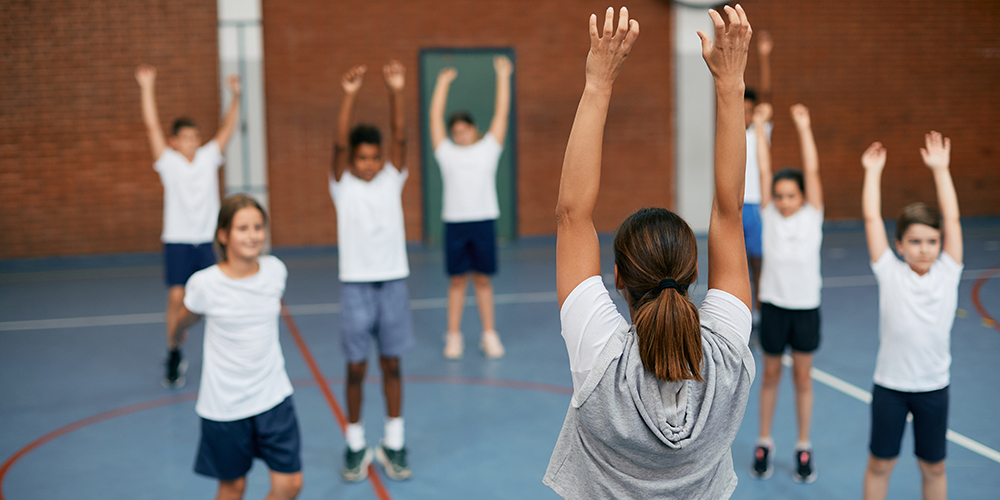
The researchers investigated how sport influenced social cognition in 100 children between the ages of 9 and 13 in the short term. To this end, they formed three groups. The first group of schoolchildren carried out 20 minutes of playful sports activities involving cooperation. This means that the task could only be accomplished with the help of others. The second group also exercised for 20 minutes. The activity was again playful, but without any cooperation, i.e. it could be completed alone. A third control group watched a sports documentary during the set time window and was thus not exposed to any physical exertion.
The researchers conducted a series of tests both before and immediately after the exercise. First, they tested the children’s ability to recognize emotions in a computer test. The children were asked to match pictures of adults to the appropriate emotion. The choices were anger, fear and joy. Their reaction speed and accuracy were recorded.
The children who completed the exercise activity on their own subsequently showed improved emotion recognition. In the group that performed the exercise activity involving cooperation, however, there was no improvement in social cognition compared to the control group that had watched the sports documentary.
No short-term effect of exercising together could be proven
Berger was surprised by these results, as the researchers had also expected positive effects from the cooperative exercise activities. She believes that the main reason for the result lies in the way the study was conducted. The intervention was limited to a single exercise session and therefore only allows conclusions to be drawn about the short-term effects of exercise.
It is likely that social cognition in cooperative sports activities would only improve if the exercise were practiced regularly over a longer period of time. The research group assumes that the unusual situation of cooperation may have already exhausted cognitive resources.
Next, the researchers want to focus on how social-cognitive skills can be strengthened through exercise in long-term training. They plan to carry out regular short exercise sessions with the schoolchildren over the course of 12 weeks. Berger explains: “We want to find out whether we can achieve better results if the children participate in cooperative sports three times a week over an extended period of time.”
Potential for positive effects is greatest in pre-puberty
The research group focuses on children between the ages of 9 and 13. “If you study the effect of exercise, the greatest potential emerges when the brain is changing: during development in childhood or during decline in older people,” explains Berger.
There is another interesting aspect in the age group studied: “At this age, there is a major social shift when, in addition to family, groups of friends become increasingly important. Children with better prosocial behavior find it easier to make connections and integrate into new groups,” says Berger.
Social exclusion, on the other hand, can foster mental illness, especially if it persists for a long time. “So if it can be scientifically proven that sport promotes social-cognitive skills, exercise programs could help children to make friends, behave prosocially and perform better academically.”
Practical application in everyday school life
However, it remains to be seen how the results could be applied in practice. The researchers are now planning to compile a collection of games that is freely accessible to teachers. Melanie Berger says: “These 20-minute exercise sessions can be easily integrated into everyday school life as an active break.”
Original publication
Melanie Berger et al.
Acute Effect of Exercise with and Without Cooperative Activities on Emotion Recognition in Preadolescent Children: A Randomized Controlled Trial
Medicine & Science in Sports & Exercise (2025), doi: 10.1249/MSS.0000000000003878