Hong Wang receives Ostrowski Prize in Higher Mathematics
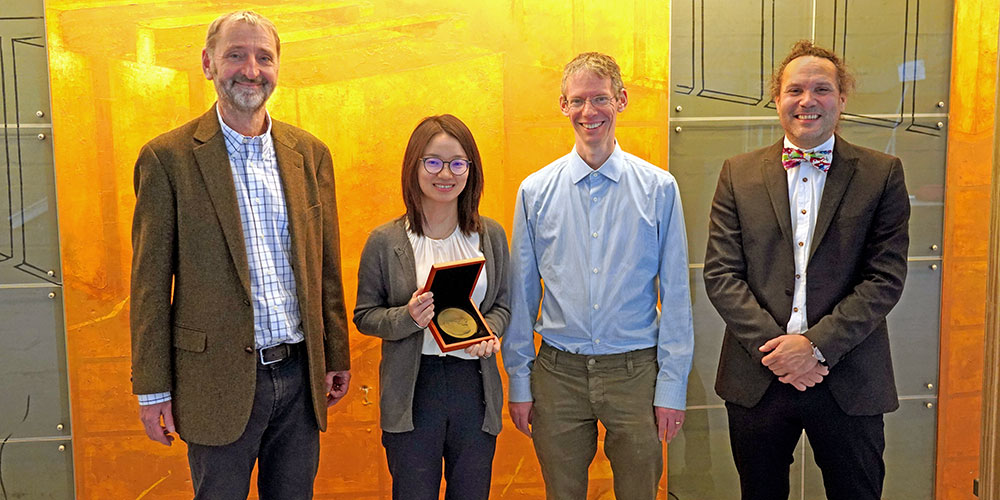
The Chinese mathematician Hong Wang has been awarded the 2025 International Ostrowski Prize in Higher Mathematics. The Ostrowski Prize is worth 100,000 Swiss Francs and is named after Alexander M. Ostrowski, a professor of mathematics who taught at the University of Basel.
10 December 2025
Hong Wang, a professor of mathematics at the NYU Courant Institute (USA) and the Institut des Hautes Études Scientifiques in Bures-sur-Yvette, received the Ostrowski Prize 2025 for her influential work in harmonic analysis, solving central problems in the field, such as the Kakeya set conjecture in three dimensions.
The Kakeya set conjecture is a central problem in restriction theory in harmonic analysis. It is a crucial roadblock – many conjectures in the field imply the Kakeya set conjecture. For a long time, the proof of the Kakeya set conjecture was out of reach, and therefore, all these other conjectures were out of reach.
The Kakeya problem was proposed in 1917 by the Japanese mathematician Sōichi Kakeya: What is the smallest possible area in which a needle can be rotated 180 degrees in a plane? Such areas are called Kakeya needle sets. The Kakeya set conjecture reads now as follows: a set in Euclidean space that contains a unit line segment in every direction must have a Hausdorff dimension equal to the dimension of the space. This has been known to be true in one and two spatial dimensions, but only partial results were known in higher dimensions. Recently, in early 2025, the Kakeya set conjecture was proven in three spatial dimensions by Hong Wang and her collaborator Joshua Zahl.
Hong Wang, born 1991, is a Chinese mathematician who works in Fourier analysis and geometric measure theory. She earned her bachelor’s degree in mathematics from Beijing University and her Diplôme d’ingénieur from Ecole Polytechnique in Palaiseau and a master’s degree from Paris-Sud University. In 2014, she started her doctoral studies in mathematics under the supervision of Larry Guth at the Massachusetts Institute of Technology.
Wang became a member of the Institute for Advanced Study, Princeton, in 2019, and an assistant professor at the University of California, Los Angeles, in 2021. In 2023, she was appointed as an associate professor at the NYU Courant Institute, where she is now a full professor, jointly with the Institut des Hautes Études Scientifiques in Bures-sur-Yvette.
An award rooted in the University of Basel
The Foundation A. M. Ostrowski for an international prize in higher mathematics was established by Alexander Markovich Ostrowski (1893–1986), a former professor of mathematics at the University of Basel. Since 1989, the foundation has awarded a prize every other year for outstanding achievements in the field of pure mathematics and in the foundations of numerical mathematics.
The jury consists of one representative of each of the following institutions: the University of Basel, the Hebrew University of Jerusalem, the University of Waterloo (Canada), the Royal Netherlands Academy of Arts and Sciences and the Royal Danish Academy of Sciences and Letters. The prize is awarded irrespective of politics, nationality, religion, or age.
This year marks the 19th awarding of the Ostrowski Prize. In 2023, it was conferred upon the Canadian mathematician Jacob Tsimerman. The award ceremony took place at the University of Copenhagen on Friday, 21st November 2025.
Further information
Prof. Dr. Helmut Harbrecht, President of the Ostrowski Foundation, University of Basel, Department of Mathematics and Computer Science, phone: +41 61 207 39 92, email: helmut.harbrecht@unibas.ch