30 years after Dayton: a country in search of itself
14 December marks the 30th anniversary of the end of the Bosnian War. Two researchers from the University of Basel are examining how its effects are being felt today, both locally and in the diaspora.
04 December 2025 | Jonas Frey
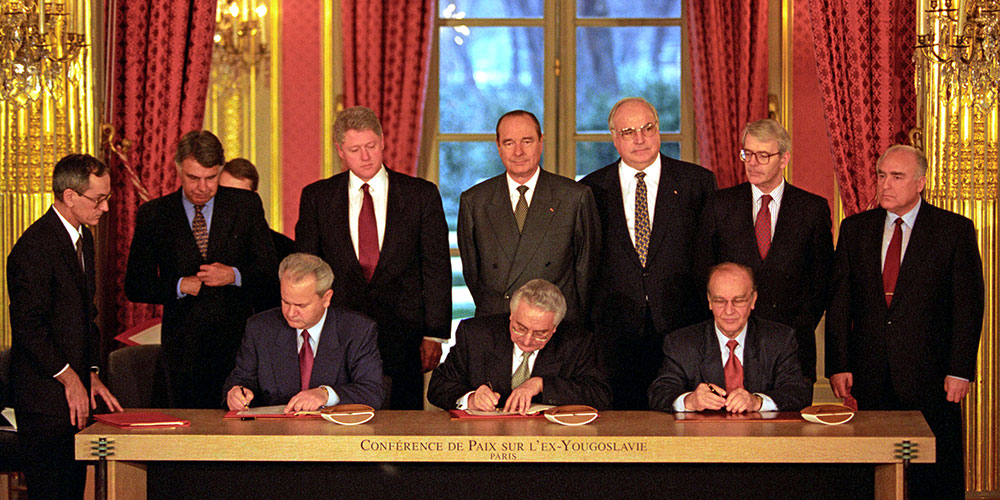
The applause was muted when the Presidents of the Republics of Bosnia and Herzegovina, Serbia and Croatia signed the Dayton Agreement at the Élysée Palace in Paris on 14 December 1995. With mediation from the United States and the European Union, the parties agreed to an immediate end to the Bosnian War, which had broken out in 1992. “It may not be a just peace, but it is more just than a continuation of war,” said the first president of the Republic of Bosnia and Herzegovina, Alija Izetbegović, at the signing ceremony.
With 100,000 dead, the Srebrenica genocide and other war crimes established by international courts, the Bosnian War was the bloodiest conflict during the disintegration of Socialist Yugoslavia between 1991 and 2001.
The Dayton Agreement divided the territory of the former Socialist Republic of Bosnia and Herzegovina into two entities: the Federation of Bosnia and Herzegovina, inhabited mainly by Bosniaks – Bosnian Muslims – and Croats, and the Republika Srpska, inhabited mainly by Bosnian Serbs.
End of war without true peace
Since 1995, the political system has been organized in a complex structure which was originally intended to create a balance between the three groups. The guns have been silent ever since. But finding a balance is particularly difficult when it comes to filling senior political offices. “And the historical narratives of all three population groups differ significantly. Over the last 30 years, there has been no rapprochement,” says Ljiljana Reinkowski. The lecturer in Southern Slavic Studies and Southeastern European Studies conducts research and teaches in the Department of Slavic Studies at the University of Basel. “The country has been stuck in an ethno-nationalist straitjacket for 30 years.” The Dayton Agreement may have frozen the war, “but it prevented the emergence of a supra-ethnic Bosnian identity that would be in the interests of the whole country.” Reinkowski also mentions the problem of tensions caused by external factors. Political interventions from Croatia and Serbia have exacerbated polarization in the country.
The fact that, since Dayton, only Bosniaks, Serbs and Croats can hold senior political positions further fuels nationalism. “The divided memory of the war is a consequence of the ethnically organized political system that has been in place since Dayton. But even in the other countries of the post-Yugoslav region, there has been no coming to terms with what happened,” says Reinkowski. “Instead, each group portrays itself as a victim.” This is most evident in the Republika Srpska, where denial of the Srebrenica genocide and other war crimes is commonplace, both at the highest political level and among large sections of the population.
Victim myths and the denial of war crimes
Self-portrayal as a victim is also evident in specific remembrance projects in the Republika Srpska. Hella Wiedmer-Newman, an art historian at the University of Basel, examines these projects in her dissertation. A recent example is the restoration of a memorial to soldiers of the Army of Republika Srpska who died in the war in Banja Luka. “The monument looks very similar to the Garden of Exile at the Jewish Museum in Berlin,” says Wiedmer-Newman. “The Republika Srpska adopts the aesthetics of Holocaust memorials in order to equate Serbs with the ultimate victims of history.”
In her analysis of these case studies, Wiedmer-Newman asks which historical narratives are presented in recent remembrance projects and whether these constitute historical revisionism. In doing so, she examines the key role played by the UN in Bosnia and Herzegovina. Since 1995, it has been monitoring compliance with the Dayton Agreement through the Office of the High Representative (OHR). “Many of the NGOs and foundations in the region are doing outstanding work and launching interesting projects,” says Wiedmer-Newman.
Art as an instrument of reconciliation?
But she takes a critical view of the practices of the UN and those of NGOs and foundations in financing art projects aimed at bringing about peace and reconciliation. “The word peace has a very strong impact on the financing of remembrance projects,” says the art historian. Some of them have indeed created places where people can come together. However, others, such as the peace memorial erected in Srebrenica in 2020 by the local government with the support of the OHR, risked reigniting conflicts. This is because the genocide that took place in the immediate vicinity is not mentioned at all.
From her case studies, Wiedmer-Newman deduces how the UN understands the concept of peace. The researcher wants to investigate whether the UN’s idea meets the expectations of people in both parts of the country. “Peace and transitional justice are themselves discourses that consist in part of symbols such as doves of peace or globes,” she says. If art projects had to fulfill the specific purpose of peace and reconciliation work, artists would risk being instrumentalized. Moreover, peace work not only takes place through institutional channels, but also in the daily coexistence of the three population groups. This fall semester, Wiedmer-Newman is also addressing this topic in a practical course in which she will try to draw comparisons with recent remembrance projects in other countries, including the planned Holocaust memorial in Switzerland.
The power of memory
Instead of drawing comparisons with the culture of remembrance in other countries, the Slavist Ljiljana Reinkowski often incorporates current political events in the post-Yugoslav region into her courses – at the moment primarily the mass protests in Serbia and the tensions in Bosnia and Herzegovina following the impeachment of Milorad Dodik, the former president of the Republika Srpska. Around 20 percent of the students in her seminars have biographical ties to the region. “They come to the courses with prior knowledge – but know that it’s not much and want to learn as much new information as possible.” For these students, the classes are also a form of identity creation.
Reinkowski observes that many second or third-generation students have an affinity for Yugo-nostalgia. However, it is difficult to say exactly what constitutes Yugo-nostalgia in the post-Yugoslav region, as there are no comprehensive studies on it. “There is indeed a discrepancy between official narratives and private memories,” says Reinkowski. Thirty years after the Dayton Agreement, this demonstrates one thing above all: “The more turbulent the current developments on the ground are, the more people cling to their own positive memories or those of older family members.”